Playbook
Why AI Never Names Your Home and Auto Insurance Agency
Independent agents write a growing share of the home and auto business in this country. Ask an AI assistant who to call about a storm claim or a teen driver's premium, and it almost never names one. Here's the mechanism, sourced live from Big "I," Conductor, 5W Public Relations, and J.D. Power, and the build order that fixes it.

18 min read
Independent agents placed 39.5% of U.S. personal lines premium in 2025, up from 39.2% in 2024 and 36.7% in 2021, the fifth straight annual gain, and 62% of all property and casualty premium written, per the Big "I" 2026 Market Share Report1. Ask an AI assistant a car or home insurance question anyway, and a 2026 study testing Perplexity, ChatGPT, Gemini, and Claude found State Farm named in 65.2% of answers and Progressive in 61.4%, while comparison sites like NerdWallet and Insurance.com were cited even more often than the carriers themselves2. No independent agency appeared in that study at all. That gap, in a channel independent agents are winning every year on paper, is what this guide closes.
What answer engine optimization means for a home and auto agency
Answer engine optimization, AEO, is the work of structuring a website so an AI assistant can find a direct answer inside it and name your agency as the source, instead of quoting a national carrier's brand page, a comparison marketplace, or nothing specific at all. Google's own documentation on AI features is explicit that AI Overviews and AI Mode require no special markup beyond ordinary Search fundamentals: a page has to be indexed and eligible to show a snippet, and the rest is the crawlability, speed, and content quality work that already mattered. That statement is scoped to Google's own product, though, and Google is only one of several platforms splitting personal-lines citations right now, alongside Perplexity, ChatGPT, Gemini, Copilot, and Claude.
Home and auto insurance is a strange test case for this, because it's the line where the content gap and the brand-recognition gap point in opposite directions. Nobody has to explain what State Farm or Progressive is. Everybody knows the jingles. But knowing a brand and publishing the specific page that answers "what do I do after a hail storm" or "does my policy cover a teen driver" are two different things, and the second one is where an independent agency can actually compete, because it's local, it's specific, and almost nobody's written it down yet.
Before you keep reading
If you want to know whether your own site currently has anything an AI assistant could quote on home or auto insurance, the free Audit reads it for AI-citation readiness in about thirty seconds. strategicaiarchitects.com/audit
Independent agents already write a growing share of this business
The scale here isn't a guess. The Independent Insurance Agents & Brokers of America, the Big "I," compiles and analyzes property and casualty premium data from AM Best every year and publishes it as the Market Share Report. The 2026 edition, covering 2025 results, found the independent agency channel placed 62% of all P&C insurance written in the U.S. in 2025, up from 61.5% in 2024, and in line with the five-year average1. Independent agencies wrote 87.7% of commercial lines premium, essentially flat against 87.9% in 2024, which is the segment where independent distribution has always dominated1.
Personal lines, the segment that covers home and auto, is the more interesting number, because it's the one independent agents have historically struggled in against direct writers and captive agents. The report puts the independent channel's personal lines share at 39.5% in 2025, up from 39.2% in 2024, continuing a climb from 36.7% in 20211. That's the fifth consecutive annual gain. A channel that's been quietly taking share from direct writers for half a decade, in the exact line most people assume belongs to a handful of national brands.
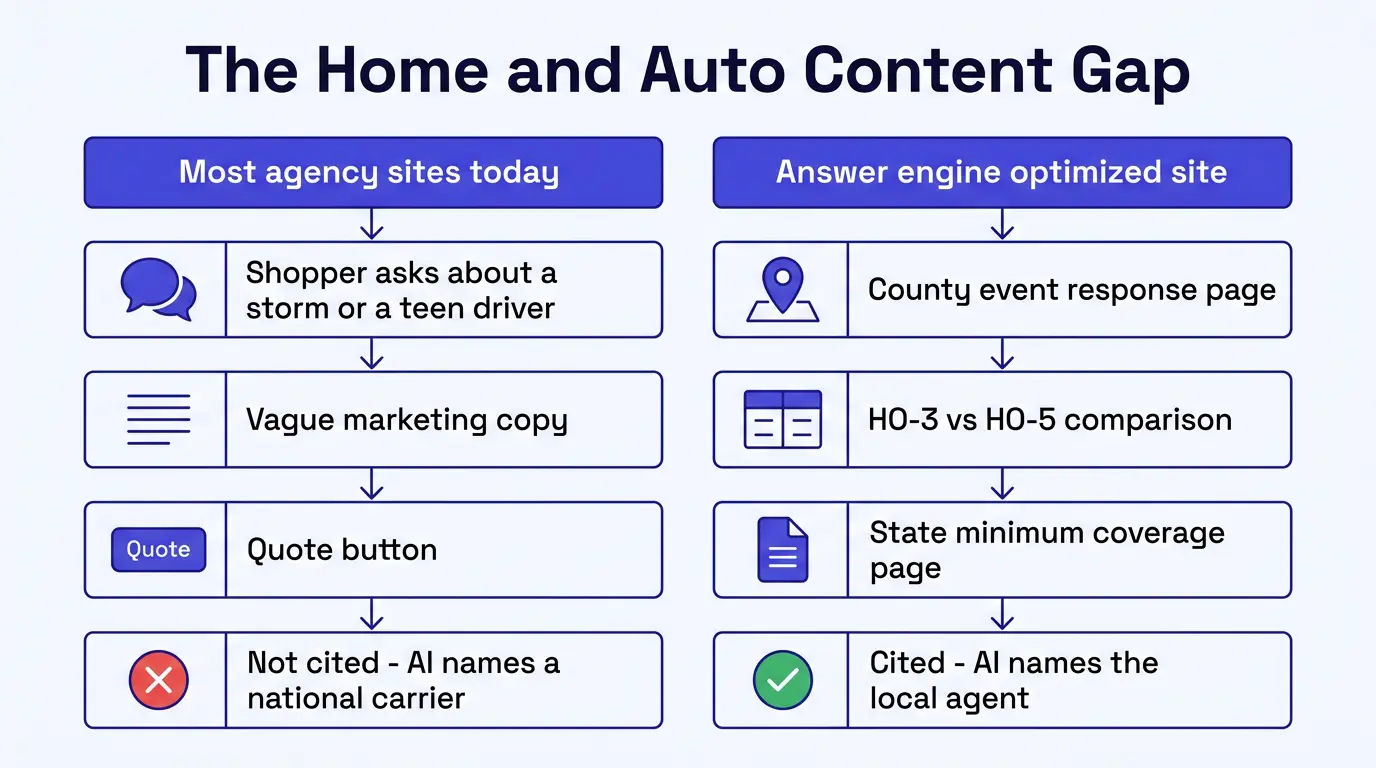
Sit with that for a second, because it cuts against the story most agents have been told. The independent channel isn't losing ground in home and auto. It's winning it, one point of share at a time, every year since at least 2021. What hasn't kept pace is the content. Most independent agency websites in this line are built the same way most final expense sites are: a homepage, a handful of carrier logos, and a quote button, with nothing published that answers the actual question a shopper typed into an AI assistant before they ever found the quote button at all.
Who actually gets named when AI answers a car or home insurance question
Conductor's 2026 Insurance AI Search Benchmarks, published August 13, 2026 and covering answer engine data from January through May 2026 and Google AI Overview data from a May 20 to June 20, 2026 window, measured where insurance citations land across six AI platforms, insurance treated as one category. Google AI Mode carried 43.9% of insurance citations, Perplexity carried 33.6%, and ChatGPT, Gemini, Copilot, and Claude split the remainder3. 40.7% of insurance searches in the study triggered an AI Overview at all, and 53.3% of those citations came from pages that didn't even rank in Google's own organic top 103. Ranking and citation are two different games, and a page can lose the first one and still win the second, if it's built to be quoted. The leading named sources in Conductor's data were a mix of brokers and carriers, Insureon at 2.9%, Progressive at 2.8%, The Hartford at 2.7%, New York Life at 2.7%, and Chubb at 2.7%3, a group with real marketing budgets and a decade of indexed content behind them, not a single independent local agency in the top names.
That's insurance-wide data, not a home-and-auto-specific measurement, and it's worth saying that plainly rather than stretching it. A separate, auto-specific study closes that gap. 5W Public Relations ran a 2026 study testing four AI systems, Perplexity, ChatGPT, Gemini, and Claude, with 24 stratified prompts repeated three times each, 288 attempts in total, 184 answers returned, specifically about auto insurance2. State Farm was named in 65.2% of answers, Progressive and Nationwide each in 61.4%, Travelers in 57.1%, and Erie in 54.9%2. The study's own authors note the appearance intervals for the top names overlap enough that the sample doesn't prove one carrier is more visible than another, which is an honest caveat worth repeating rather than hiding2.
The citation data, as opposed to the brand-mention data, told a different and arguably more useful story. Publisher and comparison sites were cited more often than the carriers themselves: NerdWallet in 53.3% of answers, Insurance.com in 52.7%, Forbes.com in 51.6%, TheZebra.com in 47.8%, and MoneyGeek.com in 45.1%2. Even among the carriers that got named most, direct ownership of the citation was thin. Only Nationwide had a meaningfully high rate of its own website actually being the cited source, at 13.6%, while State Farm, the most-named carrier by mention rate, had its own site cited in just 2.7% of answers2. The model knows the brand. It almost never has a page from that brand to actually quote. An independent agency doesn't appear anywhere in either list, not as a mention and not as a citation.
| Metric | Figure | What it means |
|---|---|---|
| Independent agent share of personal lines premium, 2025 | 39.5% | Up from 39.2% in 2024 and 36.7% in 2021. Fifth straight annual gain. |
| Independent agent share of all P&C premium, 2025 | 62% | Up from 61.5% in 2024. |
| State Farm mention rate, auto insurance AI answers | 65.2% | Highest of any carrier tested, but its own site was cited in only 2.7% of answers. |
| NerdWallet citation rate, auto insurance AI answers | 53.3% | Cited more often than any carrier's own website. |
| Independent agency mentions or citations in either study | 0 | Not named once across Conductor's six-platform insurance study or 5WPR's four-platform auto study. |
The event, local, and comparison questions shoppers bring to AI
Home and auto questions cluster around three families, and they cluster differently than a final expense or Medicare shopper's questions do, because something usually just happened. Nobody researches car insurance for fun on a Tuesday afternoon. A storm rolled through, a teenager just got a permit, a closing date is set, or a claim is already filed and the next step is unclear. Build strong pages for each family and you've covered most of what this vertical's buyers actually ask an assistant before they ever call anyone.
| Question family | Typical question | What makes the page quotable |
|---|---|---|
| Event-driven (something just happened) | "What do I do after a hail storm?" / "My teen just got their license, what changes?" / "Do I need different coverage for a short-term rental?" | A direct, step-by-step answer tied to the actual event, written before the next storm hits, not after. State what a claim timeline typically looks like and what documentation is usually needed, without promising an outcome on any specific claim. |
| Local (resolves to a county or state) | "Car insurance near me" / "What's the minimum liability coverage required in my state?" / "Does my state require homeowners insurance to get a mortgage?" | The actual state minimum limits, named and dated, plus what moves rates locally: hail and wind exposure, theft rates, state no-fault rules. A national carrier page answers nationally. A local page answers the question as asked. |
| Comparison (what's the actual difference) | "HO-3 vs. HO-5, what's the difference?" / "Replacement cost vs. actual cash value" / "Full coverage vs. liability only" | A plain, named comparison with the actual coverage difference stated in the first two sentences, the kind of question an agent answers at the kitchen table and almost no agency site answers in public. |
What a citable home and auto page actually looks like
Take the HO-3 versus HO-5 question as a worked example, because it's one of the most-searched comparison questions in homeowners insurance and one of the easiest to answer badly. A non-citable version reads like marketing copy: "we offer comprehensive homeowners coverage tailored to your needs." There's no fact in that sentence an assistant could lift, because there's no fact in it, period.
A citable version states the mechanic directly. An HO-3 policy, the most common standard homeowners form, covers the dwelling and other structures on an open-peril basis, meaning everything is covered except what's specifically excluded, while personal property inside the home is covered only against a named list of perils. An HO-5 policy extends that same open-peril coverage to personal property too, which closes a real gap for anyone whose belongings would be expensive to replace, and it typically costs more in premium for that broader protection. State both forms, state the actual coverage difference, name roughly what the broader form tends to cost in premium if you have a real range to cite, and you've written something an assistant can quote verbatim to answer the exact comparison question a homeowner typed in.
The teen driver question deserves the same worked-example treatment, because it's one of the highest-anxiety event questions in the entire personal lines category. A non-citable version says "adding a teen driver is easy and affordable." A citable version explains the actual mechanic: insurers rate a new teen driver based on age, the vehicle they'll primarily drive, their grades in many states (a good-student discount is real and underused), and whether they're added to an existing policy versus rated as a listed driver on a car they primarily use. State that premiums for a newly licensed teen driver typically rise meaningfully, and that the specific increase depends on the carrier, the vehicle, and the state, rather than citing one invented number as if it applied everywhere. The honesty about the range is itself part of what makes the page trustworthy to a human reader and quotable to a model.
The structural rules that make a page like this work are the same ones that make every page on this site citable: one question, one URL, the direct answer inside the first two sentences, a named source for every number, and a visible review date so a reader and a machine can both tell whether the figures are current.
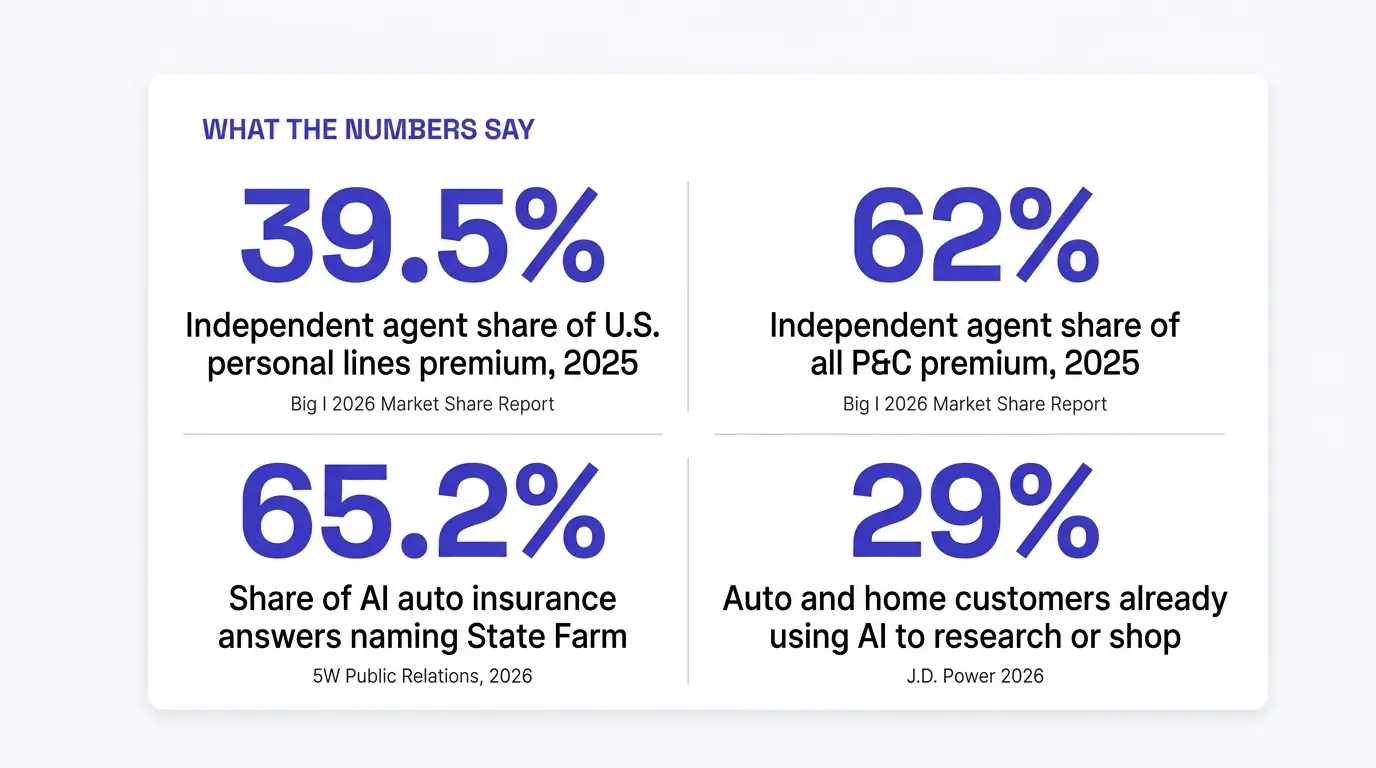
39.5%
Independent agent share of U.S. personal lines premium, 2025, up from 36.7% in 20211
62%
Independent agent share of all P&C premium written in the U.S., 20251
65.2%
Share of AI auto insurance answers naming State Farm, the top carrier tested2
29%
Share of auto and home insurance customers already using AI tools to research or shop, per J.D. Power4
Why this has to be built at the county level, not the homepage
A single homepage paragraph about "comprehensive auto and home coverage" can't answer a question that's actually local. What moves an auto rate in one county is often a theft rate or an uninsured-motorist rate specific to that area. What matters for a homeowner's claim after a storm depends on whether that county sits inside a federal disaster declaration, which changes real timelines and documentation requirements. Minimum liability limits, no-fault rules, hurricane and wind deductibles, and state insurance department advertising rules all differ by state, sometimes sharply, which means a single national-sounding answer is wrong somewhere no matter how it's written.
The fix is the same one this site has described for Medicare and ACA agencies with multi-county territories: build the answer at the level the question is actually asked. A page titled for your county, naming your state's actual minimum coverage requirements and the local storm or theft patterns that move rates there, is the page an assistant can match to a local query. A generic "auto insurance" page with your city's name swapped in isn't the same thing, and search engines increasingly treat it as the doorway page it actually is.
This is also where your Google Business Profile earns its keep for AI answers specifically, not just for the map pack. For a local question, the engines lean on local entities, and the profile is the record Google already has verified for your agency. Tying every county page to that profile, matching name, address, and service area, with Organization schema and reviews visible on the page, gives the engine a way to connect the page it's reading to a business it already trusts, instead of treating your site as an anonymous new source with no track record.
How many shoppers are already asking AI before they ask you
It's a fair question whether any of this is happening at meaningful scale yet, or whether it's still a small enough slice of shoppers to deprioritize. J.D. Power's inaugural 2026 U.S. AI Insurance Experience Study, fielded June through July 2026 across 8,352 customer evaluations spanning 24 insurance brands and eight third-party AI tools, found that 29% of auto and home insurance customers are already using AI tools to research products and coverage, service their accounts, understand coverage before filing a claim, or shop for a quote or new policy4. That's not a rounding error. Nearly one in three customers in this exact line are already in the habit.
The study also found that AI research isn't just idle browsing. Of customers who used AI to research products or coverage options, 37% changed their policy based on what they learned4, and 42% of customers who shopped for a policy with AI-assisted tools actually purchased as a result4. Usage was split close to evenly between insurer-provided AI tools and third-party apps and websites4, which matters for an agency because the third-party half of that split is exactly where ChatGPT, Perplexity, and Google's AI features sit, outside any single carrier's control and open to whichever source actually answers the question. A majority of customers, 71%, still aren't using AI for this kind of research4, so this isn't a channel that's replaced the phone call or the referral. It's a growing one running alongside them, deciding a meaningful share of first impressions before either of those happens.
What staying invisible actually costs
Three figures, from three different places, describe what's being left on the table. The first is the market itself: independent agents writing a growing 39.5% of personal lines premium, gaining ground every year since 20211. The second is where AI assistants currently point instead: national carrier brand names and comparison publishers, with zero independent agency appearances across two separate studies covering six and four AI platforms2,3. The third is the growing number of shoppers who never ask an agent anything before an AI tool shapes their first impression, 29% and climbing, per J.D. Power4.
Put plainly: a channel that's winning market share on paper is losing the first impression that now happens before most sales calls even start. Every month an assistant answers "what do I do after a hail storm" by naming a national carrier's claims page instead of a local agent's county-specific guidance is a month that shopper's first mental model of "who handles this" was written by someone else's content team, not by an agency that might actually service their claim better.
There's a compounding piece too. Because so few independent agency sites in this vertical publish anything an assistant can quote, an assistant answering a home or auto question today is choosing from a genuinely thin field of local, licensed sources. A handful of well-built county pages published now are competing against near silence from other independent agents in the same market, not against a decade of entrenched content the way a national brand's own page would be. That window closes as more agencies catch up to what this guide describes, which is exactly why building it now is worth more than building it later.
It's worth being honest about what this does and doesn't fix. Publishing sourced, local, answer-first content doesn't guarantee a citation, a ranking position, or a lead count, and no one running an honest shop should promise otherwise. What the data in this guide actually supports is narrower and still real: the pages that could get cited mostly don't exist yet for independent agents in this line, the channel writing the business is growing, and the content gap is wide enough that filling even part of it is a meaningfully different position than publishing nothing at all.
Who this fits, and who it doesn't
This build makes the most sense for an agency that already writes real home and auto business, or wants to grow that line, with county-specific content treated as a real part of the site rather than a single paragraph under a quote button. If personal lines is a meaningful part of your book, the gap described here is close to the largest single opportunity sitting on your site right now, precisely because so little independent-agent content exists locally to compete with the national brands and comparison publishers that currently own the citation.
It fits less well for an agency that writes little or no personal lines business and has no plans to grow into it. Publishing detailed coverage and claims-process content for a line you don't actually service creates a page that answers a question and then has nowhere useful to send the reader. And for every agency, none of this content substitutes for the actual coverage conversation a licensed producer has with a specific person before recommending a specific policy limit or endorsement. These pages answer the question a prospect asks before that conversation happens. They aren't the conversation itself.
For an agency running multiple offices across several counties or states, the same core pages, the event questions, the comparison questions, the state minimum limits, are worth building once, well, and adapting per county with the actual local hazard data and state rule rather than publishing one generic version with a different city name swapped in on each page. A page that reads identically across forty county pages gives an assistant forty copies of one source, not forty sources, which defeats the purpose of publishing each one in the first place.
What to publish in the next 30 days
Start with the three pages that carry the most search volume and the least compliance weight, since none of them quote a specific premium or recommend a specific coverage limit to a specific person.
A county-specific storm or event response page first. What to do and who to call in the first 48 hours after the kind of event your county actually sees most, with your state's actual claim-filing requirements named plainly, and a visible review date.
A coverage comparison page second. HO-3 versus HO-5, or full coverage versus liability only, whichever your market asks about more. State the actual coverage difference in the first two sentences, then expand with the honest tradeoff on cost and when each one makes sense.
A life-event page third. Teen driver, new home purchase, or short-term rental, whichever generates the most calls to your office already. Name the actual mechanic that changes the policy, state the honest range rather than one invented number, and link to your state's specific minimum requirements.
For each one: one question per URL, the direct answer inside the first two sentences, a named source for every figure, your state and county named explicitly, and a review date. Then check that AI crawlers aren't blocked on your robots.txt, tie the page to your Google Business Profile with matching schema, and run the pages through the free Audit to see how they score for AI-citation readiness.
How we build this
Every site we build ships the same answer-page specification described in this guide as the default, not an upsell: one question per URL, county-level pages built on public hazard and vehicle data from sources like FEMA, NOAA, and NHTSA, sourced figures with the date attached, and a full 60-point SEO/AEO checklist. Digital Foundation starts at $84 a month, billed annually, for the complete AEO-optimized site with 30 pages live on Launch Day. Starter, $247 a month, adds 2 blog posts, 2 county pages and 2 answer pages a month, Google Business Profile management and an AI chat widget. Pro, $497 a month, adds a new blog post, county page and answer page every week and a 24/7 AI receptionist that can take the after-hours claim call, and Scale, $997 a month, publishes one of each every business day. Every plan starts with a 14-day free look period, and the monthly plans have no cancellation fee5.
For an agency running a large personal lines book, a custom build scoped on a call can also wire a real quote request into the site as a tool an AI agent can call directly, not a static form with example numbers6. What matters most, regardless of which tier fits, is that the content described in this guide gets built at all. Almost none of the independent agencies competing in your market have done it yet, and the channel-wide market share data says that won't stay true forever.
Questions agents ask about home and auto AEO
What is answer engine optimization for a home and auto insurance agency, in plain terms?
It's structuring your car and home insurance pages so ChatGPT, Perplexity, Google's AI Mode, Gemini, Copilot, and Claude can lift a direct answer from them and name your agency as the source, instead of a national carrier or a comparison site like NerdWallet. The page has to exist, has to be indexed, and has to answer the exact question a shopper typed in a form a machine can quote without guessing at the rest.
Do independent agents really write much home and auto business anymore?
Yes, and a growing share of it. The Big "I" 2026 Market Share Report puts the independent agency channel's share of personal lines (auto, home, and other personal products combined) at 39.5% of premium in 2025, up from 39.2% in 2024 and 36.7% in 2021, the fifth consecutive annual gain. Independent agents also placed 62% of all property and casualty premium written in the U.S. in 2025. That's not a shrinking channel losing ground to direct writers. It's one gaining ground every year while AI search keeps naming someone else.
Why does ChatGPT name State Farm or Progressive instead of my agency when I ask about car insurance?
Because those carriers have a page, or a decade of press coverage, for every question a model might be trained on or search for, and most independent agency sites have a homepage, a quote button, and a handful of carrier logos. A 2026 study from 5W Public Relations testing Perplexity, ChatGPT, Gemini, and Claude on auto insurance questions found State Farm named in 65.2% of answers and Progressive in 61.4%, while comparison and publisher sites like NerdWallet and Insurance.com were cited even more often than the carriers themselves. An independent agency wasn't named in that study at all, not because agents don't write the business, but because the content an assistant could quote mostly doesn't exist on an agency site yet.
Doesn't my Google Business Profile already cover this?
It covers local map-pack visibility, which is a real and separate thing worth having. It doesn't give an AI assistant anything to quote when someone asks what to do after a hail storm, how a teen driver changes a premium, or whether a short-term rental voids a homeowners policy. Those are content questions, not listing questions, and a business profile has no sentences in it an assistant can lift.
Is it risky to publish specific guidance about claims, coverage, or state minimum limits?
Explaining how a mechanic works in general, what a FEMA disaster declaration typically changes about a claim timeline, what HO-3 covers that HO-5 doesn't, what a state's minimum liability limits are, isn't a recommendation to any one person and doesn't quote a premium to anyone. State the mechanic plainly, name your state's actual rule, and you've written something citable without writing something that promises an outcome to a specific prospect or adjusts a specific claim.
What's the fastest home and auto content to publish first?
Three pages, in this order: a plain explainer on what to do in the first 48 hours after a covered event (a storm, an accident, a break-in), a comparison of what a standard auto policy's liability, collision, and comprehensive coverages actually pay for, and a page on how a teen driver, a new home purchase, or a short-term rental changes a policy. None of the three requires a specific quote or a specific coverage recommendation, and all three map to the questions AI assistants are already fielding every day.
I already run Digital Foundation. Does this content get added automatically?
Not automatically, because it's specific to one line of business and the Pro and Scale tiers write to a calendar across your whole site. Flag home and auto as a priority for your next few weekly posts and county pages, and the same answer-page specification described in this guide gets applied to it. It's the same build, pointed at a line that usually has the thinnest content on an agency's own site.
How is this different from the other answer engine optimization guides on this site?
The mechanics are identical to the Medicare and health, life, final expense, and commercial guides on this site: answer-first pages, named sources, structured data, a real author, built at the county level because the questions are local. What's different is the shape of the market. Home and auto is a channel where independent agents are gaining share every year against direct writers, and it's also the line where national carrier brand recognition is strongest, which makes the citation gap wider here than almost anywhere else this site covers.
Sources
- Independent Insurance Agents & Brokers of America (Big "I"). "Big 'I' Releases 2026 Market Share Report," published June 23, 2026: independent agency channel placed 62% of all P&C insurance written in the U.S. in 2025, up from 61.5% in 2024, in line with the five-year average; independent agencies wrote 87.7% of commercial lines premium (87.9% in 2024); independent share of personal lines was 39.5% in 2025, up from 39.2% in 2024 and 36.7% in 2021, the fifth consecutive annual gain. Compiled from AM Best premium data. Verified live 2026-10-05. independentagent.com.
- 5W Public Relations. "Auto Insurance AI Visibility Leaders 2026," published September 2, 2026: 24 stratified prompts tested three times each across Perplexity, ChatGPT, Gemini, and Claude (288 attempts, 184 answers returned); carrier mention rates: State Farm 65.2%, Progressive 61.4%, Nationwide 61.4%, Travelers 57.1%, Erie 54.9%; publisher citation rates: NerdWallet 53.3%, Insurance.com 52.7%, Forbes.com 51.6%, TheZebra.com 47.8%, MoneyGeek.com 45.1%; owned-domain citation rate: Nationwide 13.6%, State Farm 2.7%. Verified live 2026-10-05. 5wpr.com.
- Conductor. "2026 AI Search & AI Overview Benchmarks: Insurance," published August 13, 2026, data period January to May 2026 (answer engines) and May 20 to June 20, 2026 (Google AI Overviews): insurance citation share by platform (Google AI Mode 43.9%, Perplexity 33.6%, ChatGPT 11.9%, Google Gemini 6.9%, Microsoft Copilot 2.1%, Claude 1.6%); 40.7% of insurance searches triggered an AI Overview; 53.3% of AI Overview citations came from pages outside Google's organic top 10; leading cited sources Insureon 2.9%, Progressive 2.8%, The Hartford 2.7%, New York Life 2.7%, Chubb 2.7%. Verified live 2026-10-05. conductor.com.
- J.D. Power. "AI Begins to Wield Significant Influence on Consumers' Auto and Home Insurance Decisions," the inaugural 2026 U.S. AI Insurance Experience Study, press release published August 27, 2026, fielded June through July 2026, 8,352 customer evaluations across 24 insurance brands and 8 third-party AI tools: 29% of auto and home insurance customers use AI tools to research products and coverage, service accounts, understand coverage before a claim, or shop for a quote or policy; 37% of those who researched with AI changed their policy based on the information they received; 42% who shopped for a policy with AI-assisted tools purchased as a result; 71% of customers are not using AI for this kind of research. Verified live 2026-10-05 via wire syndication. finance.yahoo.com.
- Strategic AI Architects. Digital Foundation pricing page: Website $84/mo billed annually (complete site with 30 pages live on Launch Day, calculators and widgets, AI CLI access, monthly report); Starter $247/mo (adds 2 blog posts, 2 location pages and 2 answer pages a month, Google Business Profile management, AI chat widget); Pro $497/mo (adds 1 blog post, 1 location page and 1 answer page every week, up to 4 languages, review harvesting, 24/7 AI receptionist); Scale $997/mo (adds 1 of each every business day, up to 10 custom pages, monthly newsletter); Full Clone, Update and Handoff $1,000 one time; 14-day free look period. Verified live 2026-10-12. strategicaiarchitects.com/digital-foundation.
- Strategic AI Architects. AI Expert / custom build service page: custom AI agents and quote tools wired to live data, scoped and priced on a call, built on the agency's own accounts and domain. Verified live 2026-10-05. strategicaiarchitects.com/ai-expert.
Talk it through
Want a second pair of eyes on it?
Free 30 minutes. Bring what you found, or bring nothing and we will look together at how AI engines read your site and which fixes move first.
See if your home and auto content gives AI anything to quote
Run the free Audit, a live AEO Audit plus a HIPAA tracking scan of your site, in under a minute.
Related reading: Home and auto insurance AEO, the service · AEO for commercial insurance agencies · Location pages that earn citations