Playbook
Why AI Search Never Names Your Final Expense Agency
Final expense premium just posted its best year in recent memory, and independent agents write most of it. Ask an AI assistant who to call about it, and the answer almost never names one. Here's the mechanism, sourced live from LIMRA, LOMA, and Conductor, and the build order that fixes it.


17 min read
Final expense new annualized premium hit $1.38 billion in 2025, up 32% year over year, on 1.3 million policies sold, up 25%, per LIMRA and LOMA's joint survey of 30 carriers1. Independent agents write 75% of that business1. At the same time, Conductor's 2026 insurance AI search benchmarks found comparison and advisory sites, not individual agencies, win the citations when an AI assistant answers an insurance question, and the top five broker and aggregator sites alone capture 43.2% of AI Overview citations in that segment2. Search "do I need a medical exam for final expense insurance" on most independent agency sites and you'll find nothing an AI assistant could quote. That gap, in the fastest-growing line most of these agencies sell, is what this guide closes.
What answer engine optimization means for a final expense practice
Answer engine optimization, AEO, is the work of structuring a website so an AI assistant can find a direct answer inside it and name your agency as the source, instead of quoting a comparison marketplace, a carrier's brand page, or nothing specific at all. Google's own documentation on AI features is explicit that AI Overviews and AI Mode require no special markup beyond ordinary Search fundamentals: a page has to be indexed and eligible to show a snippet, and the rest is the crawlability, speed, and content quality work that already mattered3. That statement is scoped to Google's own product, though, and Google is only one of six platforms splitting insurance citations right now.
Final expense is a useful, almost unfair test case for this, because the content gap is wider here than in most other lines this site covers. Type a Medicare question into an assistant and you'll often get an answer drawn from a genuine mix of agency sites, carrier pages, and CMS.gov. Type a final expense question in, "do I need a medical exam," "what's the difference between simplified issue and guaranteed issue," "how much does a $10,000 policy cost at 70," and the sources skew almost entirely toward comparison marketplaces and a handful of carrier marketing pages rewritten as articles. The independent agent, who is the one actually writing three out of every four dollars of this business, is largely absent from the answer.
Before you keep reading
If you want to know whether your own site currently has anything an AI assistant could quote on final expense, the free Audit reads it for AI-citation readiness in about thirty seconds. strategicaiarchitects.com/audit
A fast-growing market independent agents already dominate
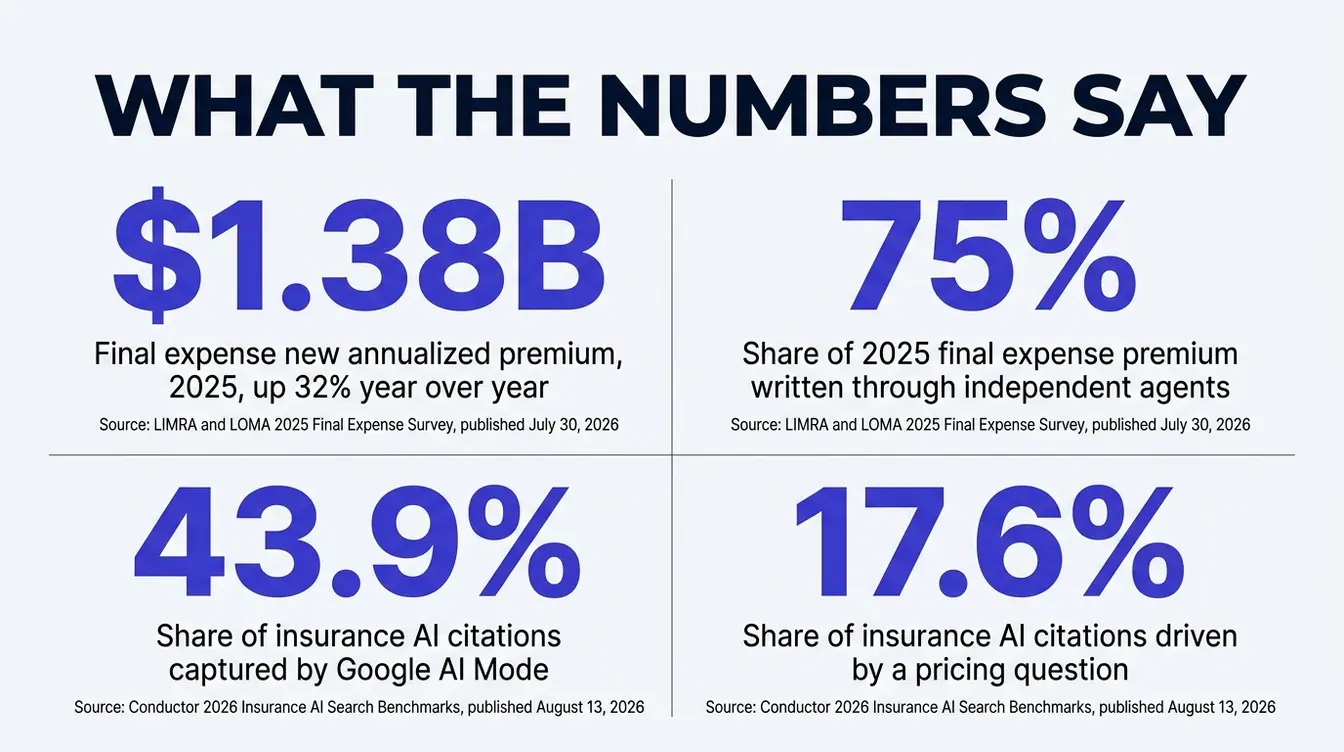
The scale here isn't a guess. LIMRA and the Life Insurers Council's joint 2025 Final Expense Survey, covering 30 participating carriers, put new annualized premium for the category at $1.38 billion in 2025, up 32% year over year, on 1.3 million policies issued, up 25%1. Seventeen of the thirty carriers surveyed grew more than 10%, and eight of those grew more than 25%1. The survey's own participants expect that pace to cool, not stop, with most anticipating a further 2% to 10% increase in 20261. This is not a shrinking or niche corner of the life insurance business. It is one of the faster-growing lines an agent can sell, and the growth is landing almost entirely on the people this content gap affects most.
That's because of who actually sells it. The same survey breaks distribution three ways: independent channels carried 75% of 2025 final expense business, affiliated channels carried 20%, and direct-to-consumer carried the remaining 5%1. Three out of every four dollars in a $1.38 billion, 32%-growth category runs through an independent agent, not a call center, not a captive carrier channel, and not a direct-to-consumer funnel. Divide the topline premium by the policy count and the average policy carries just over $1,060 a year in premium, our own calculation from LIMRA and LOMA's two published topline figures1. Small tickets, high volume, and a channel independent agents already own. The only piece missing is whether the AI answer a shopper gets before calling anyone points toward that agent at all.
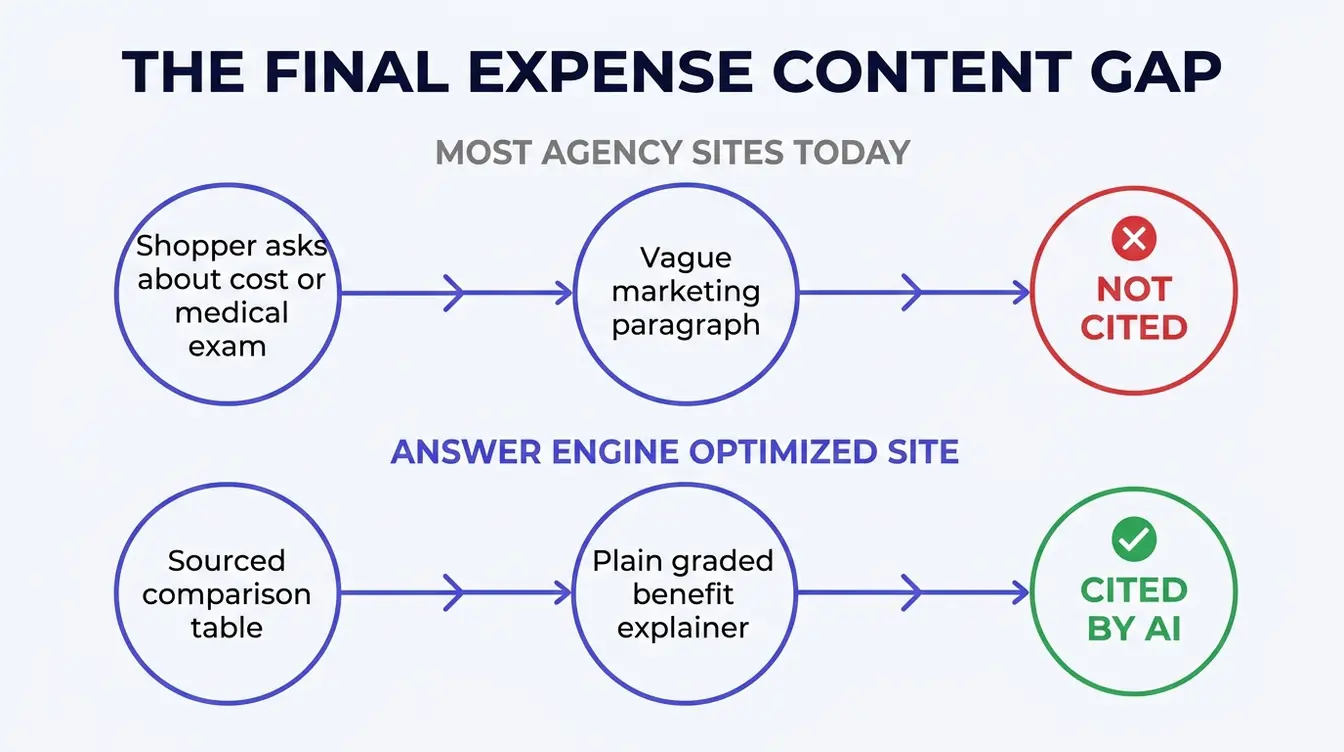
Most final expense agency sites we've reviewed are built as a single quote form with a short paragraph above it, not a content hub, which is a reasonable build for a product that closes fast once someone calls. It's also exactly the structure an AI assistant has nothing to lift from. A quote form answers "I'm ready to buy." It doesn't answer "do I need an exam" or "what's the catch with guaranteed issue," which is what most shoppers are actually asking before they're ready to fill out any form at all, let alone one on a specific agency's site.
Who actually gets named when AI answers a final expense question
Conductor's 2026 Insurance AI Search Benchmarks, published August 13, 2026, measured where insurance citations actually land across six AI platforms. Google AI Mode carried 43.9% of insurance citations, Perplexity carried 33.6%, ChatGPT carried 11.9%, Google Gemini carried 6.9%, Microsoft Copilot carried 2.1%, and Claude carried 1.6%2. 40.7% of insurance searches in the study triggered an AI Overview at all, and 53.3% of those AI Overview citations came from pages that didn't even rank in Google's own organic top 102. Ranking position and citation are two different games, and a page can lose the first one and still win the second, if it's built to be quoted.
The harder number for an independent agency is the structural one. Conductor's report states the pattern plainly: "Comparison and advisory sites won the citations. Household carriers won the mentions2." For brokers and aggregators specifically, the top five sites captured 43.2% of AI Overview citations in that segment2, and pricing questions, "how much does this cost," were the single largest intent category measured, at 17.6% of all insurance AI citations2. Put the two data sets side by side: independent agents write 75% of the actual final expense business, and comparison marketplaces, not independent agents, win the AI citations when a shopper asks the exact pricing and eligibility questions that drive that business. The people doing the work and the people getting named are two different groups right now.
The three questions every final expense shopper brings to AI
Final expense questions cluster tightly, more tightly than most lines this site covers, which makes the content easier to build correctly on the first pass. Where a Medicare shopper might arrive asking about a specific plan's formulary or a specific hospital's network, a final expense shopper is almost always asking one of three things: can I even qualify, what will this cost me, and what's the part nobody's telling me. Build one strong page for each and you've covered the overwhelming majority of what this vertical's buyers actually search for, with room left over for state-specific or carrier-specific detail once the core three exist.
| Question family | Typical question | What makes the page quotable |
|---|---|---|
| Eligibility (will I even qualify) | "Do I need a medical exam?" / "Can I get coverage with a serious health condition?" | A direct, named answer by policy type: simplified issue uses a short health questionnaire with no exam, guaranteed issue asks no health questions and requires no exam at all. State both plainly in the first two sentences, not buried under a sales pitch. |
| Cost (what will this actually run) | "How much does final expense insurance cost?" / "What does a $10,000 policy cost at my age?" | A real average or range tied to a named source, plus the honest statement that age is the single biggest driver of price. A worked hypothetical with numbers beats a vague "affordable rates" claim every time an assistant has to choose what to lift. |
| Mechanics (what's the catch) | "What's a graded death benefit?" / "What's the difference between simplified issue and guaranteed issue?" | A plain statement of the two-year waiting period on guaranteed issue, what it actually pays during that window (typically a return of premium, not the full face amount), and the honest tradeoff against simplified issue's faster full benefit. |
None of the three families require quoting a specific premium to a specific person or recommending one policy over another for someone by name. They're general-education content, which keeps them well clear of the moment a suitability or needs-based recommendation actually attaches to a conversation.
What a citable final expense page actually looks like
Take the medical exam question as a worked example, because it's one of the single most-asked questions in the category and one of the easiest to answer badly. A non-citable version reads like marketing copy: "we offer affordable final expense coverage with a simple application process." There's no fact in that sentence an assistant could lift, because there's no fact in it, period.
A citable version states the mechanic directly, by policy type. Simplified issue final expense insurance requires no medical exam, but does require answering a short health questionnaire, typically five to ten yes-or-no questions about specific conditions; a "no" answer to all of them usually clears underwriting within days. Guaranteed issue final expense insurance asks no health questions at all and requires no exam, which is why it's built for people simplified issue turned down, but it carries a graded death benefit, commonly a two-year window during which a death from natural causes pays back premiums paid plus a set percentage rather than the full face amount; death from an accident is typically still paid in full from day one. State both policy types, state the actual tradeoff, and you've written something an assistant can quote verbatim to answer the exact question a worried shopper typed in.
The structural rules that make a page like this work are the same ones that make every page on this site citable: one question, one URL, the direct answer inside the first two sentences, a named source for every number, and a visible review date so a reader and a machine can both tell whether the figures are current.
The cost question deserves the same treatment, because it carries the most search and AI-citation volume of the three families, per Conductor's 17.6% pricing-intent figure2. A non-citable version says "final expense insurance is more affordable than you think." A citable version states a real, sourced, honestly-labeled average and lets the reader do the rest of the math themselves: across the 1.3 million final expense policies LIMRA and LOMA's survey tracked in 2025, the average annual premium works out to just over $1,060, or roughly $88 a month, calculated from the survey's own topline figures and not a quote for any specific product1. Pair that average with the two coverage amounts it actually buys, state plainly that age is the single biggest driver of where an individual's premium lands within that range, and the page has answered the question in a form an assistant can lift whole.
Simplified issue vs. guaranteed issue, the comparison almost no site runs
Most of the content gap in this vertical traces back to one missing page: a plain, honest comparison of the two underwriting paths, built from LIMRA and LOMA's own 2025 survey data rather than adjectives.
| Policy type | Share of 2025 sales | Avg. face amount | What it actually requires |
|---|---|---|---|
| Simplified issue | 76% | $15,344 | A short health questionnaire, no medical exam, full benefit typically from day one if approved |
| Guaranteed issue | 24% | $11,299 | No health questions, no exam, a graded death benefit (commonly two years) before the full natural-cause benefit applies |
Publish something close to this table and chart, with your own carriers' actual simplified and guaranteed issue products layered on top, and you've built the single page most likely to answer the comparison question an assistant sees most in this category. It also happens to be the page most independent agency sites skip entirely, which is exactly why it's worth building first.
$1.38B
Final expense new annualized premium, 2025, up 32% year over year1
75%
Share of 2025 final expense premium written through independent agents1
43.9%
Share of insurance AI citations captured by Google AI Mode alone2
17.6%
Share of insurance AI citations driven by a pricing question2
Turning the graded death benefit into a trust signal
Most independent final expense sites either skip the graded death benefit entirely or bury it in a line of fine print, because it sounds like bad news: a policy that doesn't pay full value right away. Flip how it's presented and it becomes one of the stronger trust signals a final expense page can carry, which also happens to be the kind of signal an answer engine rewards.
A page that states the graded benefit plainly, "guaranteed issue coverage includes a waiting period before the full natural-cause death benefit applies, and here's exactly what's paid during that window and what isn't," tells a human reader something a vague brochure never does: your agency will say the part that isn't flattering, on purpose, before anyone asks. It gives an AI assistant the same thing in a different form, a specific, checkable mechanic it can attribute to a named source instead of a page that only asserts "guaranteed acceptance" and stops there. Assistants quote the page that answers the follow-up question nobody asked yet, not the page that avoids raising it.
The same logic applies to the health questionnaire behind simplified issue. Listing the actual categories a short questionnaire tends to cover, recent major surgery, certain diagnosed conditions, tobacco use, rather than describing it as "a few simple questions," turns a vague reassurance into a specific, citable explanation. It costs nothing to be specific about a mechanic that's already public once a carrier's own application exists. Most agency sites just never bother to write it down anywhere a shopper, or a machine reading on a shopper's behalf, can find it.
What staying invisible actually costs
Two figures, from two different places, describe what's being left on the table. The first is the market itself: a $1.38 billion category growing 32% a year, with independent agents already writing three-quarters of it1. That growth doesn't pause while agency websites catch up. Every month a shopper asks an assistant a final expense question and gets an answer sourced from a comparison marketplace instead of a licensed local agent is a month that shopper's first impression of "who handles this" was decided by someone else's content, not yours.
The second figure is about where those questions already land. Conductor's data shows 40.7% of insurance searches now trigger an AI Overview, and more than half of the citations inside those overviews, 53.3%, come from pages outside Google's own organic top 102. That's an insurance-wide number, not a final-expense-specific one, and it's worth stating that limitation plainly rather than stretching it. What it establishes honestly is that ranking well in classic search and getting cited in an AI answer are no longer the same project, and a page built only for the first one is competing in the wrong game for a growing share of this audience.
There's a compounding piece too. Because so few independent final expense sites currently publish anything an assistant can quote, an assistant answering a final expense question today is choosing from a genuinely thin field of licensed-agent sources. A handful of well-built pages published now are competing against near silence from other independent agents, not against a decade of entrenched content the way a general life insurance page would be. That window closes as more agencies catch up to what this guide describes.
It's worth being honest about what this does and doesn't fix. Publishing a sourced comparison page doesn't guarantee a ranking position, a citation, or a lead count, and no one running an honest shop should tell you otherwise. What the data in this guide actually supports is narrower and still real: the pages that could get cited mostly don't exist yet in this specific line, the market writing through independent agents is growing fast, and the cost of building the content is small next to the size of the gap it's competing to fill.
Who this fits, and who it doesn't
This build makes the most sense for an agency that already writes real final expense business, or wants to grow that line, as a named part of the site rather than a single paragraph under a life insurance tab. If final expense is a meaningful part of your book, the content gap described here is close to the largest single opportunity on your site right now, precisely because so little independent-agent content exists to compete with it.
It fits less well for an agency that doesn't actually write final expense business and has no plans to start. Publishing detailed eligibility and underwriting content you can't service creates a page that answers a question and then has nowhere useful to send the reader. And for every agency, none of this content substitutes for the actual needs conversation a licensed producer has with a specific person before recommending a specific policy. These pages answer the question a prospect asks before that conversation happens. They aren't the conversation itself.
For an FMO or an IMO running content across a downline of agent sites, the same three pages are worth building once, well, and adapting per agent with real state and carrier specifics rather than publishing one generic version with a different name swapped in on each site. A page that reads identically across forty downline sites gives an assistant forty copies of one source, not forty sources, which defeats the purpose of publishing it on each site in the first place.
What to publish in the next 30 days
Start with the three pages that carry the most search volume and the least compliance weight, since none of them recommend a specific policy to a specific person.
The simplified issue vs. guaranteed issue comparison page first. Use the table and chart above as a starting structure, swap in your own carriers' actual products, and keep a visible review date on the page.
A medical exam and eligibility explainer second. State both underwriting paths plainly in the first two sentences, then expand into the health questionnaire format for simplified issue and what "no health questions" actually means for guaranteed issue.
A graded death benefit page third. Name the waiting period your carriers actually use, state what's paid during that window versus after it, and be explicit that an accidental death is typically still paid in full from day one.
For each one: one question per URL, the direct answer inside the first two sentences, a named source for every number, and a review date. Then check that AI crawlers aren't blocked on your robots.txt, and run the pages through the free Audit to see how they score for AI-citation readiness.
How we build this
Every site we build ships the same answer-page specification described in this guide as the default, not an upsell: one question per URL, sourced figures with the date attached, and a full 60-point SEO/AEO checklist. Digital Foundation starts at $84 a month, billed annually, for the complete AEO-optimized site with 30 pages live on Launch Day. Starter, $247 a month, adds 2 blog posts, 2 location pages and 2 answer pages a month, Google Business Profile management and an AI chat widget. Pro, $497 a month, adds a new blog post, location page and answer page every week, up to 4 languages, review harvesting and a 24/7 AI receptionist, and Scale, $997 a month, publishes one of each every business day4. Every plan starts with a 14-day free look period4.
For an agency running a large final expense book alongside Medicare, ACA, or life business, a custom build scoped on a call can also wire a real premium estimator into the site, something visitors and AI agents alike can query directly instead of reading a static example5. What matters most, regardless of which tier fits, is that the content described in this guide gets built at all. Almost none of your competitors in this specific line have done it yet.
Questions agents ask about final expense AEO
What is answer engine optimization for a final expense agency, in plain terms?
It's structuring your final expense pages so ChatGPT, Perplexity, Google's AI Mode, Gemini, Copilot, and Claude can lift a direct answer from them and name your agency as the source, instead of a comparison site or a carrier's own brand page. The content has to exist, be indexed, and answer the exact question a shopper typed, in a form a machine can quote without guessing.
Do final expense shoppers really ask AI assistants instead of calling an agent first?
Conductor's 2026 insurance AI search benchmarks found 40.7% of insurance searches now trigger an AI Overview, and pricing questions make up 17.6% of all insurance AI citations, the single largest intent category measured. That is an insurance-wide figure, not a final-expense-only one, and we say so plainly. It still shows a real and growing share of this exact audience is asking a machine the eligibility and cost question before anyone picks up a phone.
Why does my agency never show up when I ask ChatGPT about final expense insurance?
Because the content an assistant can quote usually doesn't exist on an independent agency site yet. Conductor's data shows comparison and advisory sites won the citations in insurance broadly while household carrier names won the brand mentions, and the top five broker and aggregator sites alone captured 43.2% of AI Overview citations in that segment. An assistant can only name a source that answered the question first, in a form it could lift.
Doesn't final expense underwriting make this risky to write about publicly?
Explaining how simplified issue and guaranteed issue underwriting work, in general, to every reader, isn't a recommendation to any one person, so it doesn't trigger a specific suitability review the way quoting one person's exact premium would. State the two-year graded death benefit period plainly, state what's actually guaranteed and what isn't, and you've written something citable without writing something that promises an outcome to a specific prospect.
What's the fastest final expense content to publish first?
Three pages, in this order: a plain comparison of simplified issue versus guaranteed issue with real numbers instead of adjectives, a page explaining the graded death benefit period and exactly what it pays during those two years, and a page answering whether a medical exam is required, by policy type. None of the three quotes a premium to a specific person, and all three answer a question we can confirm real buyers are asking.
I already run Digital Foundation. Does this content get added automatically?
Not automatically, because it's specific to one line of business and the Scale and Pro tiers write to a general calendar across your whole site. Flag final expense as a priority topic for your next few posts and location pages, and the same sourced-answer specification described in this guide gets applied to it. It's the same build, pointed at a line that currently has almost nothing published.
Does Google's AI Overview guidance mean I don't need schema markup at all?
Google's own documentation says no special schema is required to appear in its AI Overviews or AI Mode, beyond standard indexing and crawlability. That statement is scoped to Google's own product. It says nothing about ChatGPT, Perplexity, Gemini, Copilot, or Claude, which together account for more than half of all insurance AI citations in Conductor's data. Structured markup is still what helps those other engines parse and trust a page enough to quote it.
How is this different from the other answer engine optimization guides on this site?
The mechanics are identical to the Medicare and health, life, commercial, and annuity guides: answer-first pages, named sources, structured data, a real author. What's different is the market shape. Final expense is growing faster than most adjacent lines, 75% of it is written through independent distribution, and almost none of that independent-agent side of the business has published anything an AI assistant can quote yet.
Sources
- LIMRA and the Life Insurers Council (LOMA). "Life Insurers Council: Final Expense Insurance New Annualized Premium Increased 32% in 2025," published July 30, 2026: 2025 Final Expense Survey of 30 participating carriers found new annualized premium of $1.38 billion, up 32% year over year; 1.3 million policies issued, up 25%; 17 of 30 carriers grew more than 10%, 8 of those grew more than 25%; simplified-issue policies were 76% of sales with an average face amount of $15,344, guaranteed-issue policies were 24% with an average face amount of $11,299; distribution was 75% independent, 20% affiliated, 5% direct-to-consumer; most participants expect a 2% to 10% increase in 2026. Verified live 2026-10-02. limra.com and loma.org.
- Conductor. "2026 AI Search & AI Overview Benchmarks: Insurance," published August 13, 2026: insurance citation share by platform (Google AI Mode 43.9%, Perplexity 33.6%, ChatGPT 11.9%, Google Gemini 6.9%, Microsoft Copilot 2.1%, Claude 1.6%); 40.7% of insurance searches triggered an AI Overview; 53.3% of AI Overview citations came from pages outside Google's organic top 10; "comparison and advisory sites won the citations, household carriers won the mentions"; top 5 broker/aggregator sites captured 43.2% of AI Overview citations in that segment; pricing intent was 17.6% of insurance AI citations, the largest intent category measured. Verified live 2026-10-02. conductor.com.
- Google Search Central. "AI features and your website": no additional or special schema is required to appear in AI Overviews or AI Mode beyond a page being indexed and eligible to display with a snippet under standard Search fundamentals; last updated 2025-12-10 UTC. Verified live 2026-10-02. developers.google.com.
- Strategic AI Architects. Digital Foundation pricing page: Website $84/mo billed annually (complete site with 30 pages live on Launch Day, calculators and widgets, AI CLI access, monthly report); Starter $247/mo (adds 2 blog posts, 2 location pages and 2 answer pages a month, Google Business Profile management, AI chat widget); Pro $497/mo (adds 1 blog post, 1 location page and 1 answer page every week, up to 4 languages, review harvesting, 24/7 AI receptionist); Scale $997/mo (adds 1 of each every business day, up to 10 custom pages, monthly newsletter); Full Clone, Update and Handoff $1,000 one time; 14-day free look period. Verified live 2026-10-12. strategicaiarchitects.com/digital-foundation.
- Strategic AI Architects. AI Expert / custom build service page: custom AI agents and calculators wired to live data, scoped and priced on a call, built on the agency's own accounts and domain. Verified live 2026-10-02. strategicaiarchitects.com/ai-expert.
Talk it through
Want a second pair of eyes on it?
Free 30 minutes. Bring what you found, or bring nothing and we will look together at how AI engines read your site and which fixes move first.
See if your final expense content gives AI anything to quote
Run the free Audit, a live AEO Audit plus a HIPAA tracking scan of your site, in under a minute.
Related reading: AEO for Medicare and health agencies · AEO for life insurance agencies · AEO for annuity insurance agencies