Playbook
CMS Just Let You Call Your Plan 'The Best' Again
CMS says you don't have to prove it on the page anymore. Answer engines never took your word for it either way.

18 min read
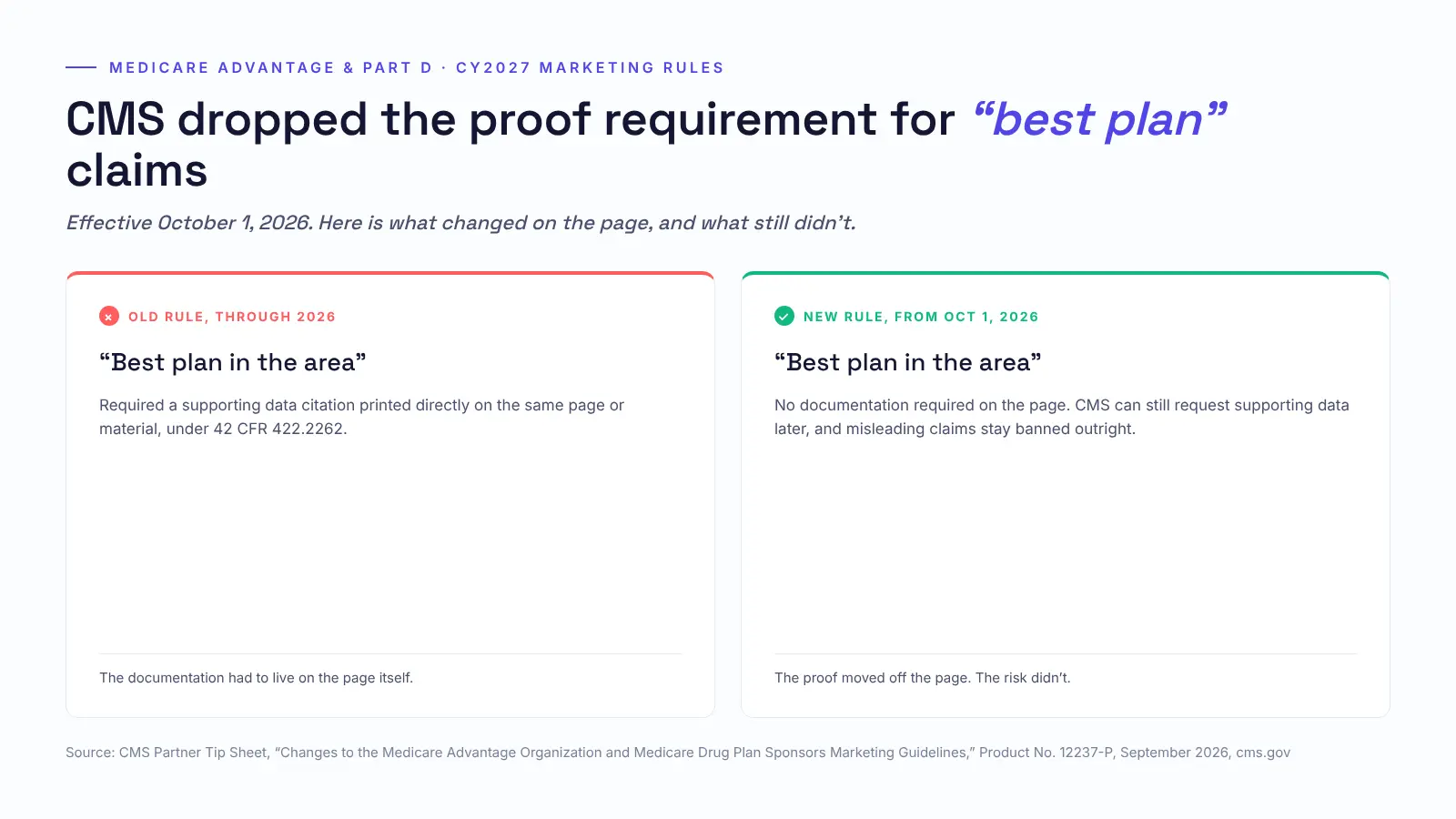
CMS's CY2027 Medicare Advantage and Part D final rule dropped the requirement that a plan print supporting documentation on any material that uses a superlative like "best" or "most," effective for all CY2027 marketing materials starting October 1, 2026.1 CMS's own language is specific about what didn't change: "in many cases, plans must still provide supporting data if CMS requests it,"1 and the general ban on misleading or confusing beneficiary information in 42 CFR 422.2262(a)(1)(i) is untouched.2 The proof moved off the page. The requirement that the claim be true, and the separate reason an answer engine ignores an unsupported adjective anyway, didn't move anywhere.
CMS dropped the proof requirement for superlatives
If you write Medicare Advantage or Part D marketing copy, you've spent years working around a specific friction point: a sentence like "the best plan in the area" or "the most complete Medicare coverage" couldn't stand alone. Under the prior version of 42 CFR 422.2262, any material using a superlative or comparative claim had to carry its supporting documentation or data source referenced directly on the same material. That's not a light lift for a landing page, a postcard, or a thirty-second radio spot, so most compliance-conscious agencies simply avoided the word "best" altogether and wrote around it.
If you write across Medicare Advantage, Part D, and anything else in an agency's book, this is the kind of rule that's easy to half-hear about during AEP prep season and then apply too broadly, or not catch at all until a compliance reviewer flags it. It deserves a plain statement of exactly what changed, exactly when, and exactly what's still true underneath it, because the gap between those three things is where the actual risk sits.
That specific friction is gone. CMS finalized its Contract Year 2027 Medicare Advantage and Part D policy rule this spring, and the agency's own partner tip sheet, "Changes to the Medicare Advantage Organization and Medicare Drug Plan Sponsors Marketing Guidelines," lists six marketing and communications guideline changes that apply to all CY2027 materials starting October 1, 2026.1 Under the heading "Advertising Language Restrictions," CMS states it plainly: "Plans no longer need to include supporting documents on materials that use superlatives (e.g., 'best,' 'most'). In many cases, plans must still provide supporting data if CMS requests it."1
Where this comes from
CMS Product No. 12237-P is a partner tip sheet published in September 2026, built to summarize the marketing and communications provisions of the CY2027 final rule (CMS-4208-F3/CMS-4212-F) for agents, brokers, and plan sponsors ahead of the Annual Election Period.1 We fetched it directly from cms.gov this session, and we cross-checked it against the current regulatory text at 42 CFR 422.2262 on Cornell Law School's Legal Information Institute, which shows the same section amended by a Federal Register entry dated early April 2026 and no longer carries the old documentation language.2
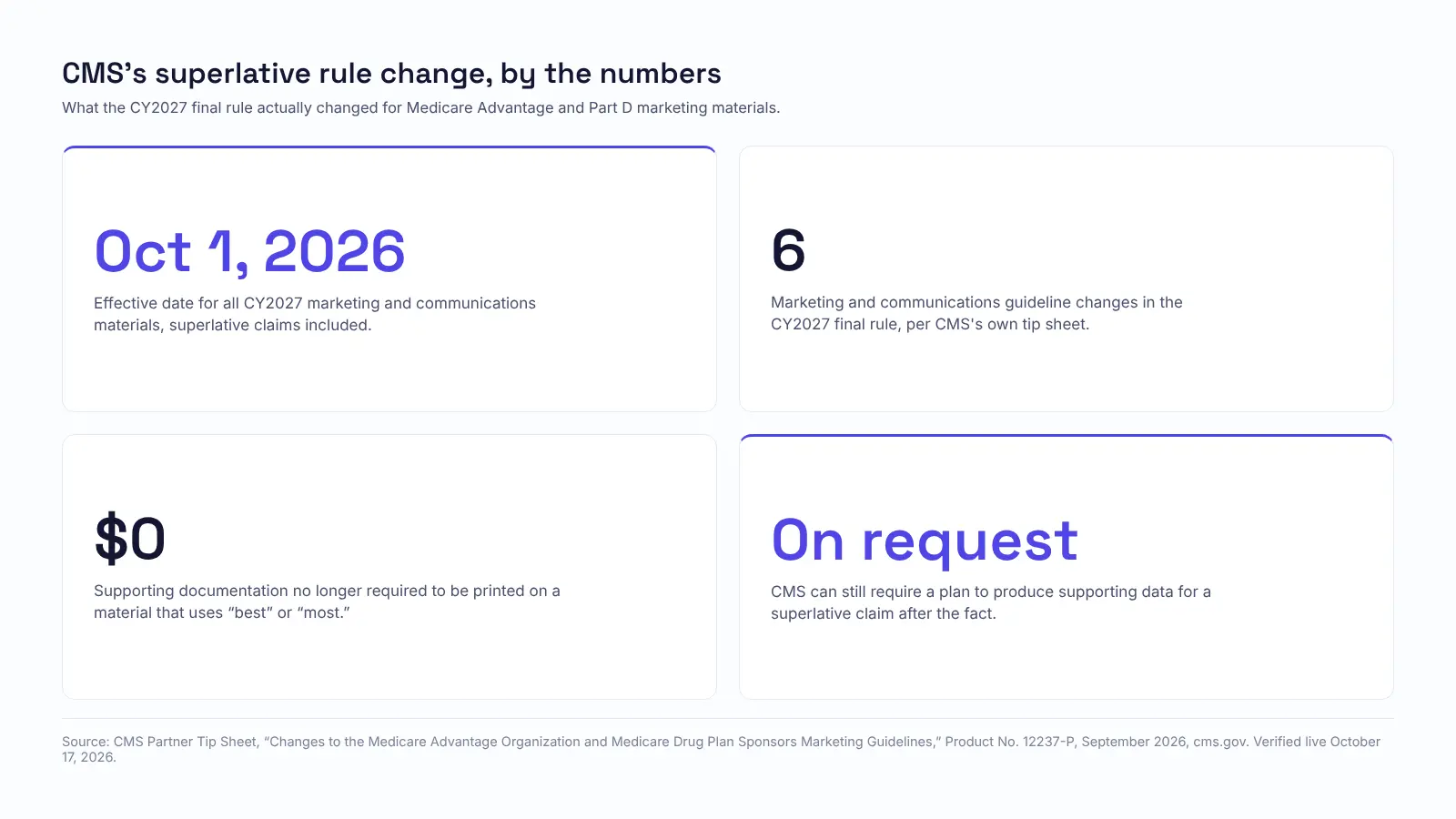
Oct 1, 2026
Effective date for every CY2027 marketing and communications material, superlative claims included1
6
Marketing and communications guideline changes in the CY2027 final rule, per CMS's own tip sheet1
$0
Supporting documentation no longer required to be printed on a material that uses "best" or "most"1
On request
CMS's own stated power to require a plan to produce supporting data after the fact1
This is one of six changes CMS grouped into the same tip sheet, and it's worth seeing where it sits next to the others, because three of the six are already their own Playbook guide and one more sits in a different part of the rule entirely.
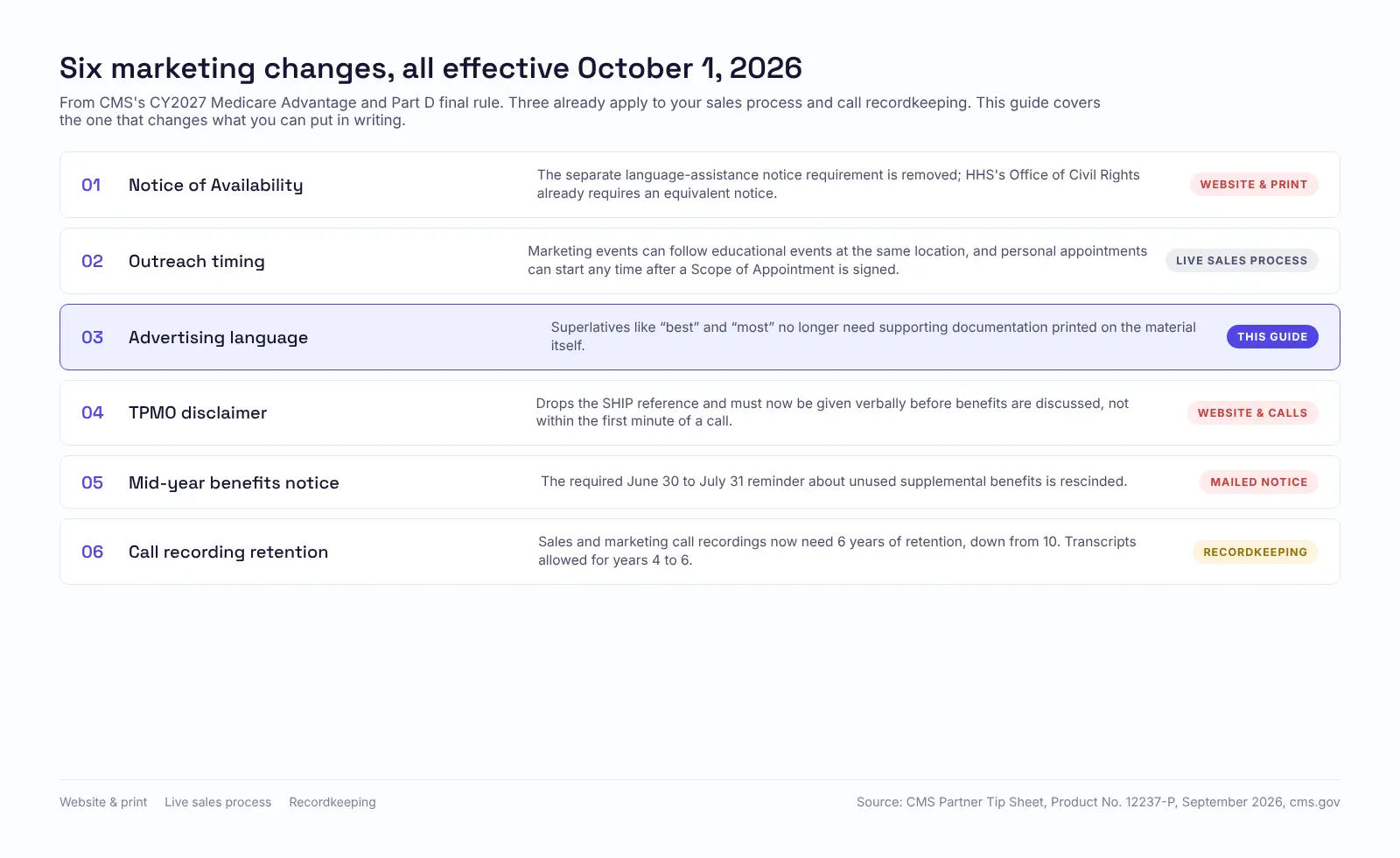
| Change | What it touches | Where to read more |
|---|---|---|
| Notice of Availability removed | Written and digital materials; HHS OCR already requires an equivalent notice | Not yet covered on The Playbook |
| Outreach timing relaxed | Scope of Appointment and educational events, a live sales process change | CMS killed the 48-hour SOA wait |
| Advertising language relaxed | Superlative claims in written and published marketing materials | This guide |
| TPMO disclaimer updated | Disclaimer wording and verbal timing, on calls and in writing | Your TPMO disclaimer changed for 2027 |
| Mid-year benefits notice rescinded | A required June 30 to July 31 mailed reminder | Not yet covered on The Playbook |
| Call recording retention cut | Recordkeeping: 6 years instead of 10, transcripts allowed years 4 to 6 | CMS's new call recording rule |
Why the documentation requirement existed
It helps to understand what the old rule was actually trying to stop before deciding what the new one changes. A superlative claim is, by definition, a comparison: calling a plan "the best" implicitly ranks it against every other plan a reader could choose instead. CMS oversees a program where a confusing or misleading comparison has real consequences, a beneficiary picks the wrong plan based on an unverifiable claim and finds out at the pharmacy counter or the specialist's office that the plan doesn't actually cover what the ad implied it did. Requiring the supporting data to sit right there on the page was a blunt but effective way to make a plan sponsor do the substantiation work before publishing, not after a complaint.
That requirement was also, by CMS's own account, somewhat redundant with a rule CMS was already enforcing elsewhere: the general prohibition on misleading or confusing materials. If a claim can't be substantiated, it's arguably misleading regardless of whether the documentation requirement exists as its own separate rule. CMS's broader CY2027 final rule leans on that redundancy argument repeatedly. Its own fact sheet groups several of the deregulatory provisions, the superlative change among the general category, under the heading "Reducing Regulatory Burden and Costs in Accordance with Executive Order 14192," describing the agency as "removing restrictions on the time and manner by which beneficiaries can have conversations with licensed agents and brokers."5 Read plainly, CMS's own framing is that it's trimming procedural steps it considers duplicative of other safeguards already in force, not relaxing the underlying safeguards themselves.
The Notice of Availability change in the same tip sheet works the same way. CMS dropped its own duplicate notice requirement because HHS's Office of Civil Rights already requires an equivalent one.1 That's the pattern across most of the six changes: CMS removing a specific procedural requirement it judges redundant, while the substantive protection the procedure existed to enforce, no misleading claims, accessible language assistance, a documented compliance trail, stays intact somewhere else in the regulatory structure. The superlative change fits that pattern exactly. The documentation-on-the-page requirement is gone. The documentation-on-request power and the ban on misleading claims are the "somewhere else" it still lives.
How the six changes split: what you publish vs. how you sell
Group the six changes by what they actually touch and a pattern falls out that's useful for deciding where your own attention belongs. Four of the six affect what ends up published, printed, or displayed: the Notice of Availability requirement, the advertising language change this guide is about, the TPMO disclaimer wording and timing, and the mid-year supplemental benefits notice. Only one, the outreach timing change covering Scope of Appointment and educational events, touches the live sales process itself. The sixth, call recording retention, is purely a recordkeeping change with no content implication at all.
That's worth knowing because it reframes how much this specific rule update actually affects your website. It's not one small item in a list of mostly-sales-process changes. Four of the six, two thirds of this year's update, land on the same surface your website already lives on. If you've been tracking this rule change as a sales-floor compliance update and nothing more, you've been under-covering where it actually applies.
What CMS didn't touch
Read the current regulatory text next to the old text and the shape of the change becomes obvious. The current version of 42 CFR 422.2262, as mirrored on Cornell Law School's Legal Information Institute and amended by the Federal Register entry tied to this rule, still opens its list of prohibited activities with "activities that could mislead or confuse beneficiaries, or misrepresent the organization."2 That's paragraph (a)(1)(i), and it carries no exception for superlatives. Everything the old superlative provision was backstopping is still backstopped. What's gone is the narrower, specific requirement that documentation live on the same page as the claim.
| Requirement | Through CY2026 | CY2027, from October 1, 2026 |
|---|---|---|
| Documentation printed on the material | Required for any superlative or comparative claim | Not required |
| Ability to substantiate if CMS asks | Required | Still required in many cases1 |
| Ban on misleading or confusing claims | In force under 422.2262(a)(1)(i) | Still in force, unchanged2 |
| Scope of this specific rule | Medicare Advantage and Part D only | Still Medicare Advantage and Part D only |
That last row matters if your agency writes across more than one line of business. This change lives in 42 CFR Part 422 and Part 423, the Medicare Advantage and Part D regulations. It has no bearing on how a state insurance department treats a comparative claim in an ACA marketplace ad, a life insurance brochure, or a final expense mailer. Most states still enforce some version of the NAIC's unfair trade practices framework against a misleading comparison in those lines, with no federal loosening attached to it. A multi-line agency that reads this rule as blanket permission to write "the best" everywhere is solving a Medicare Advantage problem with a rule that doesn't reach the rest of its book.
The trap the loosened rule sets
Here's where this gets worth a full guide instead of a one-paragraph compliance update. A rule that removes a specific procedural requirement without removing the underlying obligation creates exactly the kind of gap that's easy to walk into by accident. The temptation is straightforward: documentation isn't required on the page anymore, so why not finally write "the best plan in the area" the way marketing copy has always wanted to?
Two separate problems sit inside that temptation, and they don't fix each other.
The first is the compliance problem, and it's the narrower one. CMS's own tip sheet says "in many cases, plans must still provide supporting data if CMS requests it."1 That phrase does real work. It means the obligation to be able to substantiate the claim didn't go anywhere, it just moved from "prove it now, in public" to "be ready to prove it later, on request." An agency that writes "best plan in the area" with nothing behind it, because the page no longer requires a citation, is one documentation request away from discovering it can't actually back up what it published. The compliance risk didn't shrink. It moved downstream and got quieter, which is a worse position to be caught in, not a better one.
The second problem is the one most marketing-rule explainers skip entirely, and it's the one that actually costs you organic visibility: a page built around an unsupported superlative was never going to perform well with an answer engine, and nothing CMS did this year changed that.
What this rule change does not do
It does not make a false "best plan" claim legal. It does not remove your obligation to be able to substantiate the claim if CMS asks. It does not change anything about how ACA, life, final expense, or annuity marketing is regulated. What it removes is one specific procedural step, printing the proof on the same page as the claim, for Medicare Advantage and Part D materials only.
A worked example of how the documentation request actually plays out
Picture two versions of the same agency homepage, both published the week AEP opens. Version one reads "Call us today for the best Medicare Advantage plans in [county]." Version two reads "We write Medicare Advantage plans in [county], including the area's only 5-star-rated plan for 2027." Under the CY2027 rule, neither one needs a footnote or a citation printed on the homepage itself. Both are, on their face, compliant with the documentation-on-the-page requirement that no longer exists.
The difference shows up the moment anyone asks a follow-up question, whether that's a beneficiary, a state regulator fielding a complaint, or CMS exercising the "on request" power its own tip sheet describes. Version two has an answer ready: the current CMS Star Ratings release, the plan ID, the contract year. Version one has an adjective and nothing behind it. The agency running version one isn't necessarily doing anything CMS will catch this week. It's carrying a liability that sits quietly until the one time someone asks, and "we meant it generally" is not a response that satisfies a documentation request. Plan sponsors remain responsible for the marketing activities of the agents and brokers who represent them, which is exactly why a sponsor's compliance team is often the one asking the question before CMS ever does.
Check your own site before the next AEP mailer goes out
You don't need to wait for a documentation request to find out whether your own pages would survive one. This takes about five minutes and uses nothing but your own site's search box and a text editor.
First, pull every instance of a superlative. Search your own site for "best," "top," "most," and "#1." Don't stop at the homepage. Agency sites tend to collect these phrases fastest in email footers, PDF rate sheets, and seasonal landing pages built fast during a prior AEP and never revisited.
Second, delete the adjective and read what's left. "Call us for the best Medicare Advantage plans" becomes "Call us for Medicare Advantage plans." If the sentence still makes sense and still does its job without the superlative, the adjective was decoration, not information, and you can either cut it or replace it with the fact it was standing in for.
Third, for every superlative you decide to keep, write down what backs it up. A star rating, an enrollment count, a specific benefit a competitor's plan doesn't carry, each with a source and the plan year it applies to. If you can't fill in that blank in under a minute, that's the signal the claim isn't ready to publish yet, documentation requirement or not.
Fourth, date it. A star rating or an enrollment figure is only accurate for one plan year. A page that doesn't say which year its superlative applies to reads as stale, and arguably misleading, the moment the next plan year's data comes out, which is exactly the kind of drift the general misleading-information ban still covers.
Why answer engines never dropped their own proof requirement
CMS and an AI answer engine are not enforcing the same rule, and they were never trying to solve the same problem. CMS cares whether a beneficiary gets misled into the wrong plan. Google, ChatGPT, and Perplexity care about something narrower and, for your purposes here, more immediately relevant: which source is reliable enough to name out loud as the answer to a question.
Google's own documentation on what it calls helpful, reliable, people-first content is explicit about what earns that trust. Among the questions it tells creators to ask about their own pages: "Does the content present information in a way that makes you want to trust it, such as clear sourcing, evidence of the expertise involved" and "Does the content provide original information, reporting, research, or analysis?"3 It also flags the opposite pattern directly, asking whether "the main heading or page title" avoids "exaggerating or being shocking in nature," and whether the content is, plainly, "factually accurate."3 None of that is Medicare-specific guidance. It's Google's general standard for what a trustworthy page looks like, and a bare superlative with nothing behind it fails on every count: no sourcing, no original analysis, and nothing a reader or a model could verify.
Think about the mechanism from the model's side for a second. An answer engine deciding whether to cite your page is effectively asking the same question CMS used to force you to answer on the page itself: can this claim be checked against something specific? CMS stopped requiring you to show your work. A language model summarizing the open web to answer "what's the best Medicare Advantage plan in [county]" has no such requirement removed, because it was never CMS's rule that gave it that instinct in the first place. It's trained to prefer the passage that names a specific, checkable fact over the one that makes an unverifiable claim, and that preference doesn't update because a federal regulator eased a documentation requirement.
Go back to the two homepage versions from the worked example above. Ask an AI assistant "what's the best Medicare Advantage plan in [county]" and picture which of the two pages it has more to work with. Version one, "the best Medicare Advantage plans," gives a model nothing to anchor a citation to, no rating, no benefit, no number, just an adjective that a dozen other competing agency pages also claim about themselves. Version two hands the model a named, dated, checkable fact: a specific star rating for a specific plan year. If the model is building an answer and needs a source to name, the page with the fact is the one it has a reason to reach for. The page with only the adjective is indistinguishable from every other agency site making the same unverifiable claim, which is exactly the crowd an answer engine is built to filter out, not promote.
That's also why this isn't really a story about artificial intelligence being stricter than a federal regulator. It's a story about two different systems rewarding the same underlying behavior, specificity backed by a source, for reasons that have nothing to do with each other. CMS's version of that reward was a compliance requirement. An answer engine's version is simply which page it finds useful enough to repeat. Writing to satisfy the second one tends to satisfy the first one too, almost as a side effect.
What to publish instead of a bare superlative
None of this means you have to avoid the word "best" forever, or that persuasive marketing copy is off the table. It means the fix is the same one this blog comes back to for a reason: replace the adjective with the fact underneath it, and cite the fact.
The bare superlative
- "The best Medicare plan in the county"
- "The most complete coverage available"
- "The top choice for local Medicare members"
- No source a reader or a model could check
On the pageAn opinion with nothing attached to it
The specific, sourced version
- "The only 5-star-rated Medicare Advantage plan available in [county] for 2027, per CMS's current Star Ratings data"
- "One of three plans in [county] that includes dental, vision, and a $0 Part B premium buy-down for 2027"
- The actual enrollment figure for the plan in that county, sourced to CMS data and dated
- A claim a reader or a model can verify independently
On the pageA fact that survives a documentation request and a model's fact-check
Notice what the right-hand column has in common across all three rows: a number or a fact that's true independent of your opinion, attached to a source a reader or a model could go check. That's not a workaround for the old documentation rule. It's a better sentence on its own terms, and it happens to satisfy both the compliance instinct the old rule was built around and the trust signal an answer engine is actually looking for.
A five-minute audit of your own site
Search your own site for "best," "most," and "top." For every result, ask whether the sentence survives if you delete the adjective and the sentence has to stand on a fact alone. If it doesn't survive, that's a page to rewrite, whether or not CMS requires anything printed on it. If you'd rather have someone else run this check, the free Audit scores your site's sourcing and citation readiness in about a minute.
How we build this in
This is the same discipline we hold every guide on this blog to, including this one: a figure doesn't go on the page unless we fetched it this session, named the source, and stated the date it covers. We re-fetched our own pricing before writing this, because quoting a price from memory is exactly the kind of error this guide is about.
Digital Foundation's Starter tier runs $247 a month and ships 7 new pages a month, including 2 blog posts, 2 location pages, 2 answer pages, and 1 custom page, plus the full 60-point SEO/AEO checklist.4 Pro runs $497 a month and adds up to 15 to 18 new pages a month across blog, location, and answer pages, plus a 24/7 AI voice receptionist.4 Scale runs $997 a month and ships up to 76 new pages a month, one blog post, one location page, and one answer page every business day.4 Every tier includes a 14-day free look before billing starts.4
The reason this matters for a guide about superlative claims specifically: every page our build ships is written to the same rule this guide argues for, a specific, sourced, dated fact instead of an adjective with nothing behind it. That's not a separate feature bolted on for compliance. It's the same checklist running whether the topic is a plan's star rating, a county's enrollment count, or a premium figure for the current plan year.
We build on Astro, which ships zero JavaScript by default, so a page like this one arrives as finished HTML instead of a runtime the browser has to boot before anything loads.4 Our builds score 90+ on Lighthouse performance on both mobile and desktop, and some score 100, which matters here for a reason beyond raw speed: a page that loads slowly on a phone is a page fewer prospects and fewer crawlers ever finish reading, no matter how carefully it's sourced. A perfectly cited page that never finishes loading on a phone earns the citation nobody sees.
What changes for your agency
Nothing here promises a specific citation, a ranking position, or a guaranteed pass on a future compliance audit, because nobody can source a guarantee like that honestly. What changes is more concrete than that, and it starts before any answer engine or any CMS documentation request ever enters the picture.
A page that survives a documentation request
The source is already attached to the claim, so "can you prove that" has an answer on file, not a scramble.
Copy an answer engine can actually check
A specific, dated fact is the shape of claim a model can verify and cite. An adjective isn't.
One fewer rule to track by hand
You don't have to remember which CY2027 change applies to which page. The habit of sourcing every claim covers all six.
A clear line for your other lines of business
You know this specific CMS change doesn't travel into ACA, life, or final expense marketing, so you don't apply it where it doesn't belong.
None of that requires treating this as a bigger regulatory event than it is. It's one procedural step removed from one part of one rule, for one line of business. The reason it's worth your attention anyway is the gap it opens between "technically compliant" and "actually works," the gap between a page that satisfies the letter of the new rule and a page that still earns a click, a citation, or a documentation request answered without panic. That gap was always there. The only thing that changed on October 1, 2026 is that CMS stopped papering over it for you.
Questions agents ask
Can a Medicare agent now call a plan "the best" in marketing materials?
CMS no longer requires a Medicare Advantage organization or Part D sponsor to print supporting documentation on a piece of marketing that uses a superlative like "best" or "most," effective for CY2027 materials starting October 1, 2026. That is narrower than "you can say anything." The general ban on misleading or confusing information in 42 CFR 422.2262(a)(1)(i) is untouched, and CMS can still ask a plan to produce the supporting data after the fact. The documentation moved off the page. The requirement that the claim be true didn't move anywhere.
What exactly did CMS change about superlative claims for 2027?
Before this rule, 42 CFR 422.2262 required a plan to reference its supporting documentation or data directly in any material that used a superlative or comparative claim. CMS's own partner tip sheet states plainly that plans "no longer need to include supporting documents on materials that use superlatives," while noting that "in many cases, plans must still provide supporting data if CMS requests it." The change is one of six marketing and communications guideline changes in the CY2027 Medicare Advantage and Part D final rule, all effective October 1, 2026.
Does this mean CMS can't ask for proof anymore?
No. CMS's own language is "in many cases, plans must still provide supporting data if CMS requests it." The obligation to be able to substantiate a claim didn't disappear, it just stopped being a requirement that the proof sit printed on the page, brochure, or website itself at the moment of publication.
Is the general ban on misleading marketing still in effect?
Yes, and it was never part of this change. The current text of 42 CFR 422.2262(a)(1)(i) still bars "activities that could mislead or confuse beneficiaries, or misrepresent the organization." A superlative claim that's actually false is still a misleading claim, with or without a documentation requirement attached to it.
Does this CMS rule apply to my website, or just sales calls?
It applies to marketing and communications materials broadly, which includes a public website, not only scripted sales calls. The six CY2027 changes split roughly into two groups: some touch what you publish (the advertising language change, the TPMO disclaimer wording, the Notice of Availability removal, the mid-year benefits notice), and some touch the live sales process (Scope of Appointment timing, joint educational and marketing events) or recordkeeping (call recording retention). The superlative change sits squarely in the first group. If your site has a page that says "the best Medicare plan in the area" or similar, this rule is about that page.
If CMS allows a vague superlative now, why would an AI assistant still penalize it?
CMS's documentation rule and an answer engine's trust signals are two separate systems with two separate goals. CMS is regulating marketing compliance. An answer engine like ChatGPT, Perplexity, or Google's AI Overview is trying to decide which source to trust enough to quote and attribute. Google's own guidance on what it calls helpful, reliable, people-first content asks whether a page presents information "in a way that makes you want to trust it, such as clear sourcing, evidence of the expertise involved," and whether it provides original reporting or analysis rather than a generic claim. A bare "best plan in the area" sentence has no source to check and nothing specific to verify, regardless of what CMS requires on the page.
What should I actually put on my site instead of "best plan in the area"?
Replace the adjective with the fact underneath it. Instead of "the best Medicare Advantage plan in the county," state the specific thing that's actually true and checkable: the plan's star rating this contract year, its $0 premium status, the specific benefit it includes that a competing plan doesn't, each with the source and the plan year named. A reader and an answer engine can both verify a specific claim. Neither can verify an adjective.
Does this rule change apply to ACA, life insurance, or final expense marketing too?
No. This specific change lives in 42 CFR Part 422 and Part 423, which govern Medicare Advantage and Medicare Part D prescription drug plans. ACA marketplace plans, life insurance, final expense, and annuities are marketed under a different set of rules, mainly state insurance advertising regulations and each state's unfair trade practices act, which generally still expect a comparative or superlative claim to be substantiated. If you write across more than one line, don't assume this specific CMS change travels with you into your other product lines.
Sources
- Centers for Medicare & Medicaid Services. "Changes to the Medicare Advantage Organization and Medicare Drug Plan Sponsors Marketing Guidelines," Partner Tip Sheet, CMS Product No. 12237-P: summarizes six marketing and communications guideline changes finalized in the CY2027 Medicare Advantage and Part D final rule, all effective for CY2027 materials beginning October 1, 2026, including "Plans no longer need to include supporting documents on materials that use superlatives (e.g., 'best,' 'most'). In many cases, plans must still provide supporting data if CMS requests it." Published September 2026. Fetched live October 17, 2026. cms.gov/files/document/changes-medicare-advantage-organization-medicare-drug-plan-sponsors-marketing-guidelines.pdf.
- Cornell Law School, Legal Information Institute. 42 CFR 422.2262, "Required materials and content," current text: paragraph (a)(1)(i) retains the prohibition on "activities that could mislead or confuse beneficiaries, or misrepresent the organization," with no superlative-documentation language present in the current version; amendment citation 91 FR 17583 (Apr. 6, 2026). Verified live October 17, 2026. law.cornell.edu/cfr/text/42/422.2262.
- Google Search Central. "Creating helpful, reliable, people-first content": guidance on clear sourcing, evidence of expertise, original reporting and analysis, and factual accuracy as trust signals for ranking and citation. Verified live October 17, 2026. developers.google.com/search/docs/fundamentals/creating-helpful-content.
- Strategic AI Architects. Digital Foundation service page: Starter $247/mo (7 pages/mo: 2 blog, 2 location, 2 answer, 1 custom), Pro $497/mo (15 to 18 pages/mo plus 24/7 AI voice receptionist), Scale $997/mo (up to 76 pages/mo, one of each page type per business day), all tiers include the 60-point SEO/AEO checklist and a 14-day free look. Verified live October 17, 2026. strategicaiarchitects.com/digital-foundation.
- Centers for Medicare & Medicaid Services. "Contract Year 2027 Medicare Advantage and Part D Final Rule" fact sheet (CMS-4208-F3/CMS-4212-F), confirming the final rule and its marketing and communications provisions, with a link to the Federal Register publication. Verified live October 17, 2026. cms.gov/newsroom/fact-sheets/contract-year-2027-medicare-advantage-part-d-final-rule.
Talk it through
Want a second pair of eyes on it?
Free 30 minutes. Bring what you found, or bring nothing and we will look together at how AI engines read your site and which fixes move first.
See whether your own claims would survive a documentation request
Run a free Audit and see how your site scores for sourcing, AI citations, and HIPAA safe tracking, in about a minute.
Related reading: Your TPMO disclaimer changed for 2027 · CMS killed the 48-hour SOA wait · Why your AI-written Medicare ad might violate CMS rules