Playbook
Google's AI Gets 57% of Life Insurance Answers Wrong
A client asked an AI assistant about their coverage before they ever called you. One large, hand-checked audit found the answer was wrong more than half the time on life insurance, and wrong about one in eight times on Medicare. Here is what the model gets wrong, why, and the page that corrects it.

19 min read
A large, hand-reviewed audit of Google's AI Overview found errors in 57% of its life insurance answers and 13% of its Medicare answers, out of 1,000 queries checked.1 It is a single, self-reviewed source from a company that sells insurance, so treat the number as directional, not gospel, but a separate, independently run 2024 study of general personal finance AI Overviews found a comparable pattern, 43% misleading or incorrect.3 Meanwhile, Pew Research Center's behavioral data shows almost nobody checks: when an AI summary appears, people click a traditional organic result only 8% of the time, versus 15% without one, and click the source link inside the summary itself just 1% of the time.2 Your prospect's question already got answered, probably imperfectly, and almost nobody is going to click through to find out.
Your client already got an answer before they called
Somebody searching "does whole life insurance cost less when you're younger" or "do I have to sign up for Medicare at 65 if I'm still working" is not landing on your site first anymore. They are typing the question into Google, and Google is handing them a paragraph at the top of the results page before a single blue link appears. They read it. Some of them close the tab satisfied. A smaller number keep going, find your agency, and call. By the time they reach you, they already have an opinion about their own coverage, and that opinion came from a summary nobody checked.
That would be a minor detail if the summary were reliably accurate. It is not, at least not according to the largest hand-checked audit of this specific question that we could find, and it is worth knowing exactly how it is wrong before you decide what, if anything, to do about it. Choice Mutual, a life insurance company, had its team manually review 1,000 Google AI Overview results, 500 triggered by life insurance questions and 500 by Medicare questions, and marked each one as either fully correct or containing an error.1 Life insurance answers came back wrong 57% of the time. Medicare answers came back wrong 13% of the time.1
We want to be straight with you about what kind of number that is, because the sourcing standard we hold ourselves to on this blog does not let us hand you a statistic and move on. Choice Mutual sells life insurance. Its CEO is named as the person who personally reviewed the life insurance half of the audit. The published write-up does not state when the AI Overview results were captured, from what location, or on what device, and "correct" versus "has errors" is a binary call with no published rubric for borderline cases.1 None of that makes the finding false. It does mean a single, self-reviewed source with a commercial stake is not the same thing as a government statistic, and we are telling you that before we build an entire guide around the number, not after.
What we can and can't verify here
We can verify that Choice Mutual published this study, that it claims the 57% and 13% figures from a 1,000-query manual review, and that its specific example errors check out against independent sources once you read them closely, which we did below. We cannot independently reproduce the audit itself, confirm exactly when the AI Overview snapshots were taken, or rule out that a company selling life insurance had a reason to frame the finding as dramatically as possible. Read the number as "a serious, large sample study found this, from a source with a stake in the answer," not as an independently audited government figure.
What makes the number worth building a guide around anyway is that it is not an isolated claim. An earlier, separately conducted study from The College Investor tested 100 AI Overview results across banking, credit, investing, taxes, and student loans in October 2024 and found 43% were misleading or inaccurate, with 12% flatly wrong.3 Different company, different year, different topic set, same general shape: a meaningful share of AI-generated financial guidance does not hold up when a human who knows the subject checks it line by line.
Why the model gets this specific stuff wrong
An AI Overview is not a calculator and it is not a licensed agent. It is a language model summarizing whatever text ranks well for a given query, weighted toward whatever phrasing shows up most often across the pages it was trained on or retrieves at answer time. That design is genuinely good at a lot of things. It is a bad fit for insurance questions specifically, because insurance rules are built almost entirely out of exceptions, and exceptions are exactly the detail that gets lost when you compress many pages into one paragraph.
Take the Medicare example from the audit. The AI Overview told a user they could delay Part B enrollment without a penalty as long as they still had group health coverage through an employer.1 That sentence is true often enough that it is the version most generic finance content repeats. It is also missing the one detail that decides whether it actually applies to the person reading it: the rule only works when the employer has 20 or more employees. Someone working for a 12-person agency who delays Part B on the strength of that sentence can walk straight into a late enrollment penalty that follows them for the rest of their Medicare coverage.
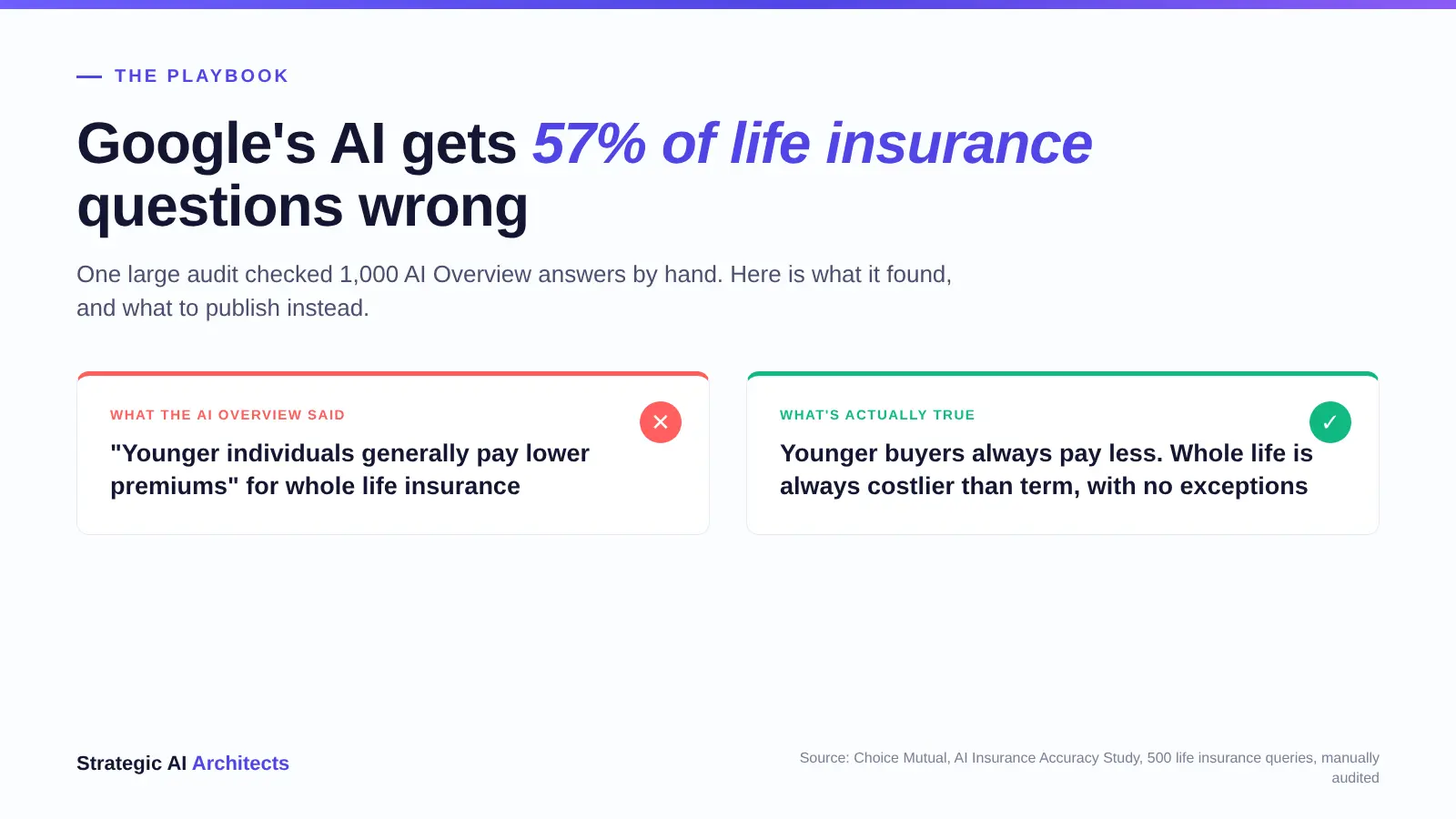
The life insurance example works the same way in reverse. Asked about the cost of whole life insurance, the AI Overview said "younger individuals generally pay lower premiums," phrased as a tendency rather than a rule.1 In reality, there is no version of whole life pricing where an older applicant pays less than a younger one for the same coverage, and there is no version where whole life costs less than a comparable term policy. Those are structural facts about how the products are priced, not statistical tendencies with exceptions. A model trained to sound appropriately hedged on genuinely uncertain topics applies the same hedge to a topic that has no exceptions to hedge about.
This is also why the error rate is so different between the two topics in the audit. Medicare rules are published in one place, codified in federal regulation, and repeated fairly consistently across the sites a model would have trained on, which is likely why its error rate was lower, 13%, even though the one error the audit did catch was a genuinely costly omission. Life insurance pricing and underwriting rules live across thousands of inconsistent carrier pages, blog posts, and comparison sites with varying quality, giving a model far more conflicting phrasing to average together, which likely explains the much higher 57% error rate.1 Thin source material in, thin and sometimes wrong summary out.
Three questions, and what the model left out
Reading the audit's own example errors closely is more useful than the headline percentage, because the mechanism only becomes obvious once you see the exact sentence next to the exact correction. Here are three of them, as the audit describes them.
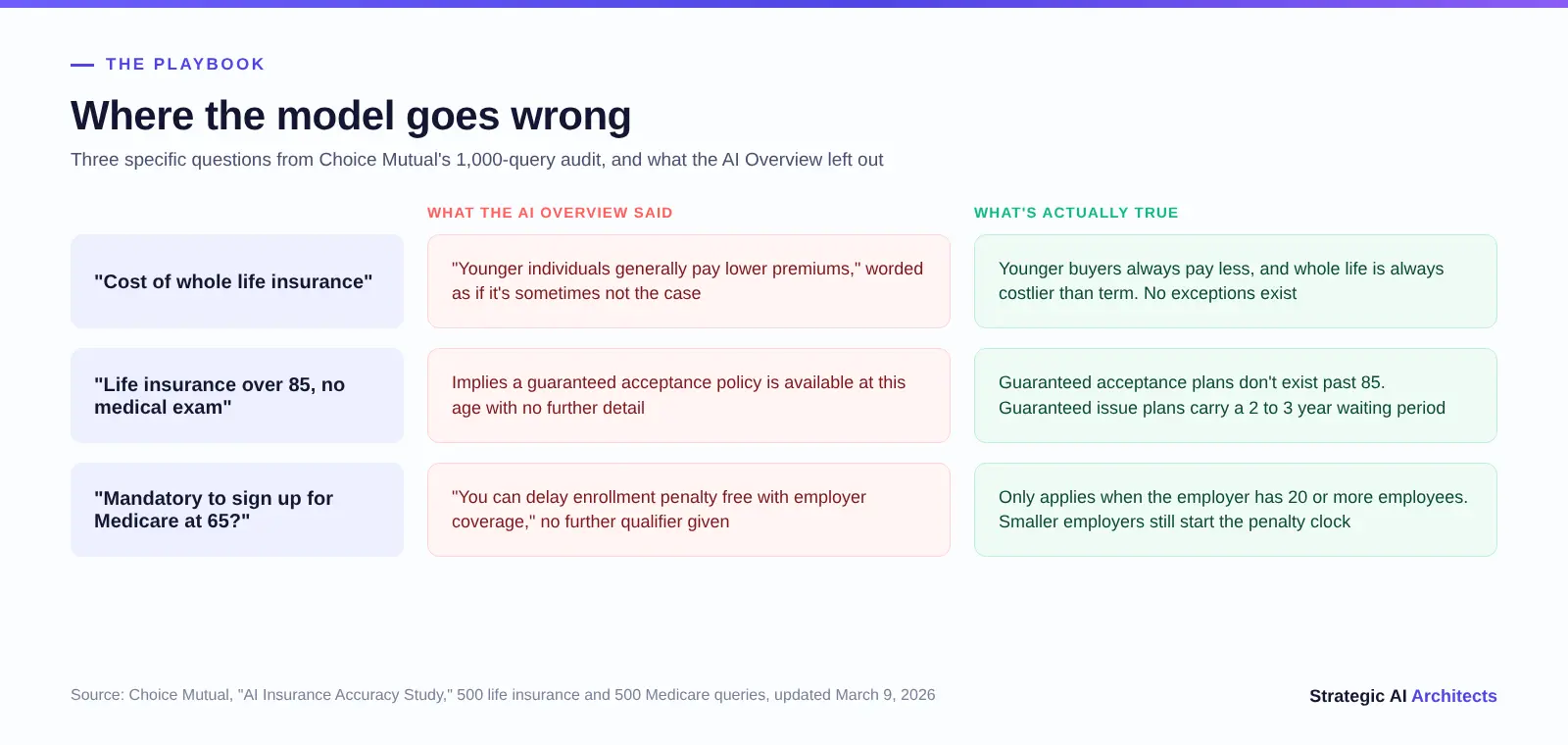
| The question asked | What the AI Overview said | What's actually true |
|---|---|---|
| Cost of whole life insurance | "Younger individuals generally pay lower premiums," worded as a tendency rather than a rule.1 | Younger buyers always pay less, and whole life is always costlier than a comparable term policy. There is no exception. |
| Life insurance over 85, no medical exam | Implies a guaranteed acceptance policy is available at that age, with no further qualifier.1 | Guaranteed acceptance plans do not exist past 85. Guaranteed issue plans, a different product, carry a 2 to 3 year waiting period before the full death benefit pays. |
| Mandatory to sign up for Medicare at 65? | "You can delay enrollment penalty free with employer coverage," no employer size mentioned.1 | Only applies when the employer has 20 or more employees. Smaller employers' coverage does not pause the Part B penalty clock. |
Notice what all three corrections have in common. None of them contradict the AI Overview's general direction. Younger people really do tend to pay less for life insurance in casual conversation about most products. Employer coverage really can delay Medicare enrollment. Guaranteed acceptance language really does appear in the final expense market at younger ages. The model is not inventing nonsense. It is dropping the one qualifying detail that turns a roughly-true generalization into a reliable, specific answer, and that detail is exactly the part a reader needs before acting on it.
The Medicare example is worth sitting with a little longer, because the stakes are concrete and official. Medicare.gov's own guidance states the rule plainly: "you'll pay an extra 10% for each year you could have signed up for Part B, but didn't," and that penalty is "usually charged for as long as you have that type of coverage," which for most people means a lifetime addition to the Part B premium.6 A client at a 15-person employer who read the AI Overview's unqualified sentence and delayed enrollment for three years on the belief that employer coverage protected them is not looking at a minor paperwork correction. They are looking at a 30% permanent increase to their Part B premium, for the rest of the time they carry Part B, because one missing clause in a search result told them a rule applied to their situation when it didn't.
That is also exactly why this isn't ordinary hallucination, the kind where a model invents a fact that doesn't exist anywhere. Every sentence in the audit's examples is true somewhere. The failure is narrower and, in a way, harder to catch: the model picked the version of the statement that applies to most people and presented it as if it applies to everyone, with nothing in the phrasing to signal that a reader should check whether they're the exception. A reader has no cue to go verify a sentence that sounds complete and reads confidently. The danger lives entirely in what's absent, not in what's said.
What a wrong answer that nobody corrects actually costs
A wrong AI answer is only expensive if two things both happen: the reader trusts it enough to act, and nobody with better information intercepts it first. Pew Research Center ran the cleanest study we found on exactly that second part, tracking the real browsing behavior of 900 U.S. adults across 68,879 actual Google searches in March 2025, then separately re-collecting the search results themselves in April 2025 to see which ones carried an AI summary.2 Of those searches, 12,593 produced an AI summary.2
The click-through numbers are stark. When an AI summary appeared, a user clicked through to a traditional organic search result in just 8% of visits. Without one, that number was 15%, almost double.2 Even more telling: users clicked a link inside the AI summary itself, meaning the one path that would lead them to a primary, checkable source, in only 1% of visits where a summary was shown.2 And sessions ended entirely on the search results page, no click at all, 26% of the time with a summary present versus 16% without one.2
57%
AI Overview answers about life insurance that contained an error, per Choice Mutual's 500-query audit1
13%
AI Overview answers about Medicare that contained an error, same audit1
8% vs 15%
Click-through to an organic result with an AI summary present vs without one2
1%
Share of visits where someone clicked the actual source link inside the AI summary2
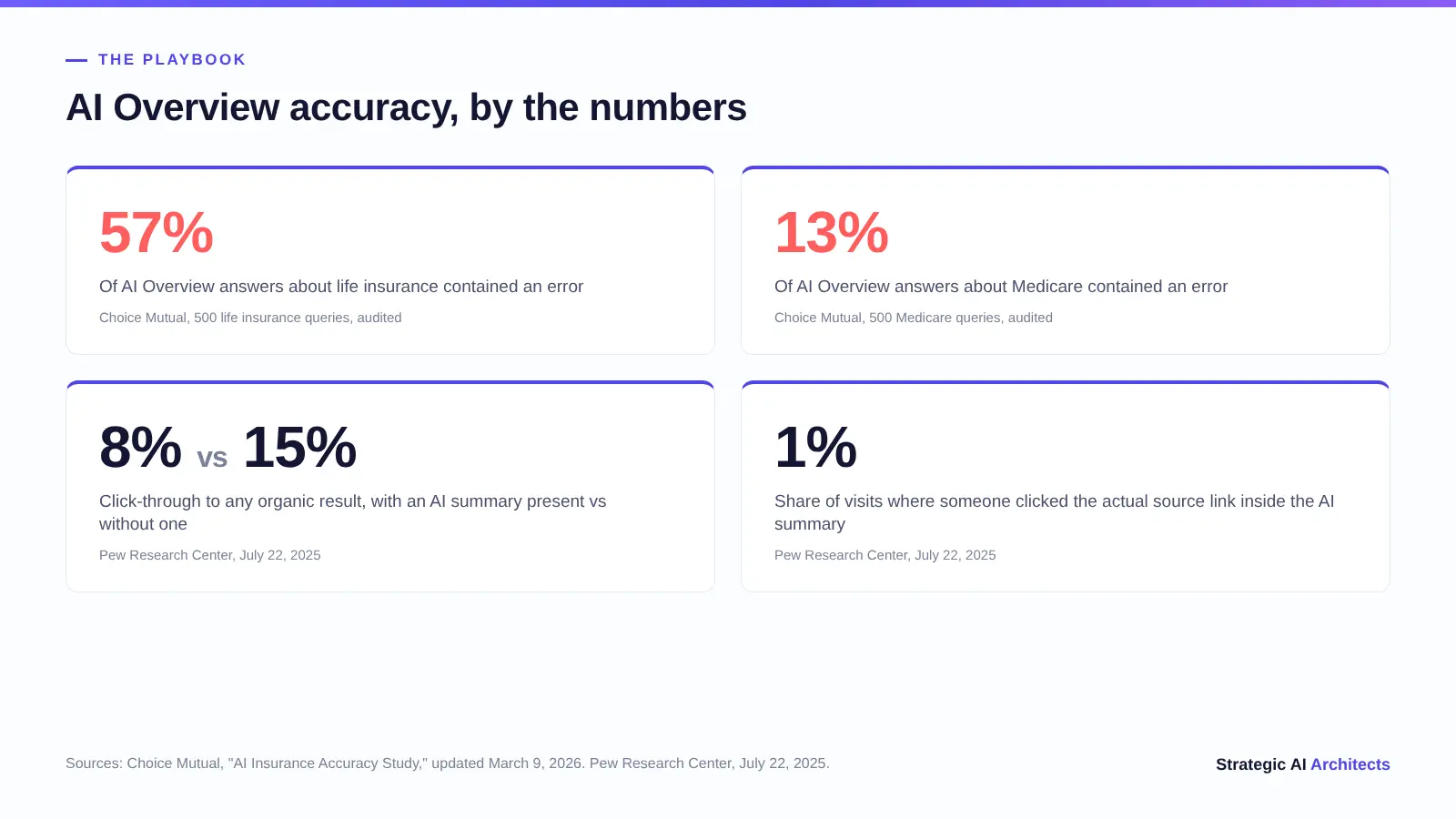
Put those two data sets next to each other and the cost becomes concrete. If something close to half of life insurance AI Overview answers contain an error, and 92% of the people who see one never click through to anything that could correct it, a meaningful share of the prospects researching coverage this week are walking into a conversation already carrying a wrong idea nobody flagged. Some will ask you about it, and you get to correct it on the spot. A larger share will not think to ask, because the answer felt authoritative enough that it never occurred to them it might be incomplete.
Line the three error rates up and a pattern appears. Medicare sits lowest at 13%, life insurance sits highest at 57%, and general personal finance from the 2024 study lands in between at 43%.13 That ordering tracks how concentrated each topic's source material is. Medicare rules come from one federal regulator and get repeated fairly consistently across the sites that cover them. Personal finance topics, banking, credit, taxes, span many institutions with their own house rules, giving a model more room to blend conflicting phrasing. Life insurance sits at the fragmented end of that spectrum: thousands of carriers, each with its own underwriting rules, pricing tiers, and marketing language, summarized by a model that has no reliable way to tell a universal pricing rule from one carrier's promotional claim. The more fragmented the source material, the higher the error rate, and insurance product rules are about as fragmented as source material gets.
Worth checking before you keep reading
Ask an AI assistant one question your agency gets asked weekly, in your own line of business, and read the answer the way an underwriter would. If you find the same kind of dropped qualifier the audit found, you've found your first page to publish. If you'd rather have someone else check your site's own AI readiness first, the free Audit scores it in about a minute.
Check the questions your own prospects are asking
You do not need Choice Mutual's audit to know which questions are worth checking. You already have the list. It is whatever your office gets asked on the phone every week: the age cutoffs, the waiting periods, the enrollment deadlines, the "is this actually true" questions that come up right before someone decides whether to trust you. Here is a five-minute way to turn that list into a publishing plan.
1. Write down the three questions you correct most often
Not the broad topics, "life insurance" or "Medicare," the actual sentence a client says out loud: "I heard I don't need Part B if my job covers me." "I thought everyone qualifies for a no-exam policy at any age." Those sentences are search queries other people are typing into an AI assistant right now.
2. Ask an AI assistant the question, plainly
Type it the way a client would, not the way an agent would. Read the answer looking specifically for a qualifier that's missing: a threshold, a waiting period, a state-specific rule, an age cutoff, anything that turns a general statement into a precise one.
3. Check whether your own site already answers it correctly
Search your own site for the exact qualifier the AI answer is missing. If it is not there in a page an answer engine could actually find and cite, you have a gap, whatever your site says elsewhere about the broader topic.
4. Note the source you would cite for the correction
A correction without a named source is just your opinion against the model's. For a Medicare rule, that is the federal regulation or an official government page. For a product rule, that is the carrier's own filed policy language. Write down where you would point a skeptical reader before you publish anything.
If you write across more than one line of business, the dropped qualifier tends to follow a pattern specific to that line, which makes it easier to know where to look first.
Medicare and ACA
Watch for enrollment timing rules stated without the employer-size, income, or household qualifier that decides whether they apply.
Life insurance
Watch for pricing or underwriting statements phrased as tendencies when the actual rule has no exceptions, like the whole life example above.
Final expense
Watch for "guaranteed" language that drops the age ceiling or waiting period that separates guaranteed acceptance from guaranteed issue.
Annuities
Watch for surrender period or liquidity statements given as a flat rule when they actually vary by specific contract and carrier.
None of this requires us to audit every line for you here. It requires the same five-minute habit, applied to whichever lines your own agency actually writes, with the question phrased the way your own clients ask it rather than the way a product brochure does.
When this isn't worth chasing
Not every dropped qualifier is worth its own page. A question nobody in your market actually asks, or a nuance so narrow it affects a handful of households a year, costs more in publishing effort than it returns in corrected decisions. The questions worth this work are the ones you already answer out loud, repeatedly, because somebody keeps arriving with the same wrong assumption. If you can't remember the last time a client repeated a specific wrong idea back to you, that particular page can wait.
How to publish the correction
The fix is not a general "improve your content" project. It's a specific kind of page, built around one precise question and the one detail a generic source drops. We've written at length elsewhere about the full mechanics of getting an answer engine to trust and cite a page.4 For this specific problem, three things matter more than the rest.
| Step | What it involves |
|---|---|
| 1. Title the page as the exact question | Match the phrasing a client actually uses, not the formal product name. "Do I need Medicare Part B if my job covers me" beats "Medicare Part B enrollment overview." |
| 2. Answer the precise exception in the first two sentences | State the qualifier the generic answer drops, immediately, before any background or context. The threshold, the age cutoff, the waiting period, named plainly. |
| 3. Cite the primary source by name | Link the federal rule, the carrier's filed language, or the regulator's own page. A correction with no named source is just a second opinion. |
| 4. State the date the rule was current as of | Insurance rules change by plan year. A page that doesn't say which year it describes gets treated as stale the moment the rule updates. |
| 5. Mark it up as a direct answer, not a blog essay | A short, quotable paragraph, FAQ schema, and a clear heading structure make the correction easy for a model to lift cleanly, instead of burying it inside a long narrative. |
None of this requires guessing what an answer engine wants. It requires the same discipline that makes any insurance content defensible: say the specific rule, name the source, date it, and stop. The surprising part is how rarely agency sites already do this for the exact questions their own clients ask out loud every week.
How we build this in
This is the exact kind of page our Digital Foundation build is designed to keep producing. The Pro plan ships 4 to 5 new blog posts and 4 to 5 new answer pages every month, and the Scale plan ships up to 22 of each, every one built on the same static Astro foundation with a clean schema stack, so a short, precise correction page is cheap to publish and fast to load rather than a project that competes for a developer's time.5 Every tier also ships the full 60-point SEO and AEO checklist, which is what keeps a page like this structured the way an answer engine actually reads it, not just the way a visitor does.5
We re-fetched our own pricing before writing this: Starter runs $247 a month, Pro runs $497, and Scale runs $997, each with a 14-day free look before billing starts.5 None of that is a guess. It's what the live page says today, because a price we quoted from memory is exactly the kind of error this guide is about.
The deeper point is the same one running through this whole guide. An answer engine rewards the page that states one specific, sourced, dated fact plainly. That's also just what good insurance communication looks like, with or without an AI assistant in the loop. Building a site that keeps publishing those pages on a real schedule is not a trick for winning citations. It's the same discipline your business already depends on, pointed at the web.
What changes for your agency
None of this promises a specific citation, a ranking position, or a lead count, because nobody can source a guarantee like that honestly. What it changes is more basic than that, and it starts before any answer engine even enters the picture: you know, in writing, with a source attached, what you'd tell a client who repeats a wrong AI answer back to you, instead of relying on memory in the moment. Everything past that is upside, not the core value.
A real answer waiting when they check
The specific exception your clients actually ask about, stated plainly, sourced, and dated.
A correction you can point to on the call
Instead of arguing with what an AI assistant said, you hand them the sourced version.
Pages built to be cited, not just read
Short, dated, sourced answers are the shape of content both readers and answer engines can use.
A publishing habit, not a one-time project
New questions come up every week. A real cadence means the library keeps growing.
Questions agents ask
How many AI Overview answers about insurance actually contain an error?
One large audit, run by Choice Mutual, manually checked 1,000 AI Overview results, 500 for life insurance questions and 500 for Medicare questions. It found errors in 57% of the life insurance answers and 13% of the Medicare answers. That is a single study, not a government statistic, and it is worth reading the next question before you repeat the number.
Is that 57% figure actually reliable?
Treat it as directional, not definitive. Choice Mutual is an insurance company with a commercial interest in the topic, its CEO personally reviewed the life insurance results rather than an independent panel, and the published methodology does not state when the AI Overview results were captured or from what location. None of that means the finding is wrong. It does mean it is a single, self-reviewed source, and the honest move is to say so rather than repeat the number as settled fact.
Why does an AI Overview get life insurance and Medicare questions wrong specifically?
An AI Overview is built to summarize what the open web already says about a topic, not to apply a rule correctly. Insurance questions are full of exceptions that live in the fine print rather than in the first sentence of a generic finance article: a waiting period that only applies past a certain age, a threshold that only triggers at a specific employer size, a premium rule that holds everywhere except one plan type. A model trained to summarize popular phrasing drops the exception and keeps the generalization, because the generalization is what most of the source text says.
Does this happen with ChatGPT and Perplexity too, or just Google's AI Overview?
The Choice Mutual audit and the earlier College Investor study both tested Google's AI Overview specifically, not ChatGPT or Perplexity, so we cannot hand you a tested error rate for either of those by name. What we can say is that the underlying mechanism, summarizing a general pattern instead of applying a specific rule, is not unique to one company's model. Treat every AI assistant's insurance answer as unverified until a primary source backs it, regardless of which logo is on it.
If I publish a corrected answer page, does that actually change what the AI says?
There is no guarantee for any single page, and anyone who promises one is overselling. What is true, and sourced, is that answer engines favor passages that are specific, sourced, and dated over generic summaries, and a page that states the exact exception a generic source misses is exactly the kind of passage that gets pulled into a future answer or, at minimum, outranks the vague competitor in the citations a reader actually clicks.
What's the difference between being cited and being correct?
Being cited means an answer engine named your page as a source. Being correct means what the page says is actually true. The two overlap less than people assume. A thin, confidently worded page can get cited and still be wrong, and a precise, well sourced page can go uncited for months before an engine decides to trust it. Chasing citations alone is not the same project as publishing accurate answers, even though the second one is the only honest way to earn the first.
Should I stop telling clients to use ChatGPT or Google at all?
That is not realistic advice and clients will not follow it. A more useful habit is to ask, early in a conversation, what they already found when they looked something up, and to treat the answer as a worksheet to correct rather than an insult to argue with. The client who says an AI assistant told them something that sounds wrong is handing you the exact moment where you earn the relationship.
What should I actually publish first?
Start with the specific exception, not the general topic. A page titled around the broad subject of whole life insurance competes with thousands of similar pages. A page that states plainly, with a source and a date, that guaranteed acceptance life insurance does not exist past a certain age, or that an employer's exact size decides a Medicare penalty, is narrow enough to be the obvious answer to one precise question, which is the shape of page that both a reader and an answer engine can actually use.
Sources
- Choice Mutual. "Data Shows AI Answers 57% of Life Insurance Questions Wrong," AI Insurance Accuracy Study: manual review of 1,000 Google AI Overview results (500 life insurance, 500 Medicare queries) by the company's own team; life insurance error rate 57%, Medicare error rate 13%; methodology does not state capture date, location, or device, and the life insurance review was performed personally by the company's CEO. Updated March 9, 2026. Verified live October 16, 2026. choicemutual.com/original-research/insurance-ai-accuracy-study.
- Pew Research Center. Athena Chapekis and Anna Lieb, "Google users are less likely to click on links when an AI summary appears in the results," published July 22, 2025: tracked 900 U.S. adults' real browsing across 68,879 Google searches in March 2025, re-collected matching search results in April 2025; 12,593 searches produced an AI summary; organic click-through 8% with a summary present versus 15% without; link clicks inside the summary itself 1%; session ended on the results page 26% with a summary versus 16% without. Verified live October 16, 2026. pewresearch.org.
- Search Engine Journal, reporting The College Investor's study, "Google's AI Fails At 43% Of Finance Queries, Study Finds," published October 21, 2024: 100 AI Overview results tested across banking, credit, investing, taxes, and student loans; 43% misleading or inaccurate, 12% completely incorrect, 57% accurate. Verified live October 16, 2026. searchenginejournal.com, original study at thecollegeinvestor.com.
- Strategic AI Architects. "Getting Cited by AI in 2026: What Actually Moved, and What Agencies Should Build Next," published July 24, 2026. strategicaiarchitects.com/post/aeo-for-agencies-what-changed-2026.
- Strategic AI Architects. Digital Foundation service page: Starter $247/mo, Pro $497/mo (4 to 5 blog posts and 4 to 5 answer pages monthly), Scale $997/mo (up to 22 blog posts and 22 answer pages monthly), all tiers include the 60-point SEO/AEO checklist and a 14-day free look. Verified live October 16, 2026. strategicaiarchitects.com/digital-foundation.
- Medicare.gov. "Avoid Late Enrollment Penalties": Part B penalty is "an extra 10% for each year you could have signed up for Part B, but didn't," charged "for as long as you have that type of coverage," a lifetime addition for most people. Verified live October 16, 2026. medicare.gov/basics/costs/medicare-costs/avoid-penalties.
Talk it through
Want a second pair of eyes on it?
Free 30 minutes. Bring what you found, or bring nothing and we will look together at how AI engines read your site and which fixes move first.
See how your own site answers these questions
Run a free Audit and see how your site scores for speed, AI citations, and HIPAA safe tracking, in about a minute.
Related reading: AEO for life insurance agencies · Ranking isn't what gets you cited · Getting cited by AI in 2026